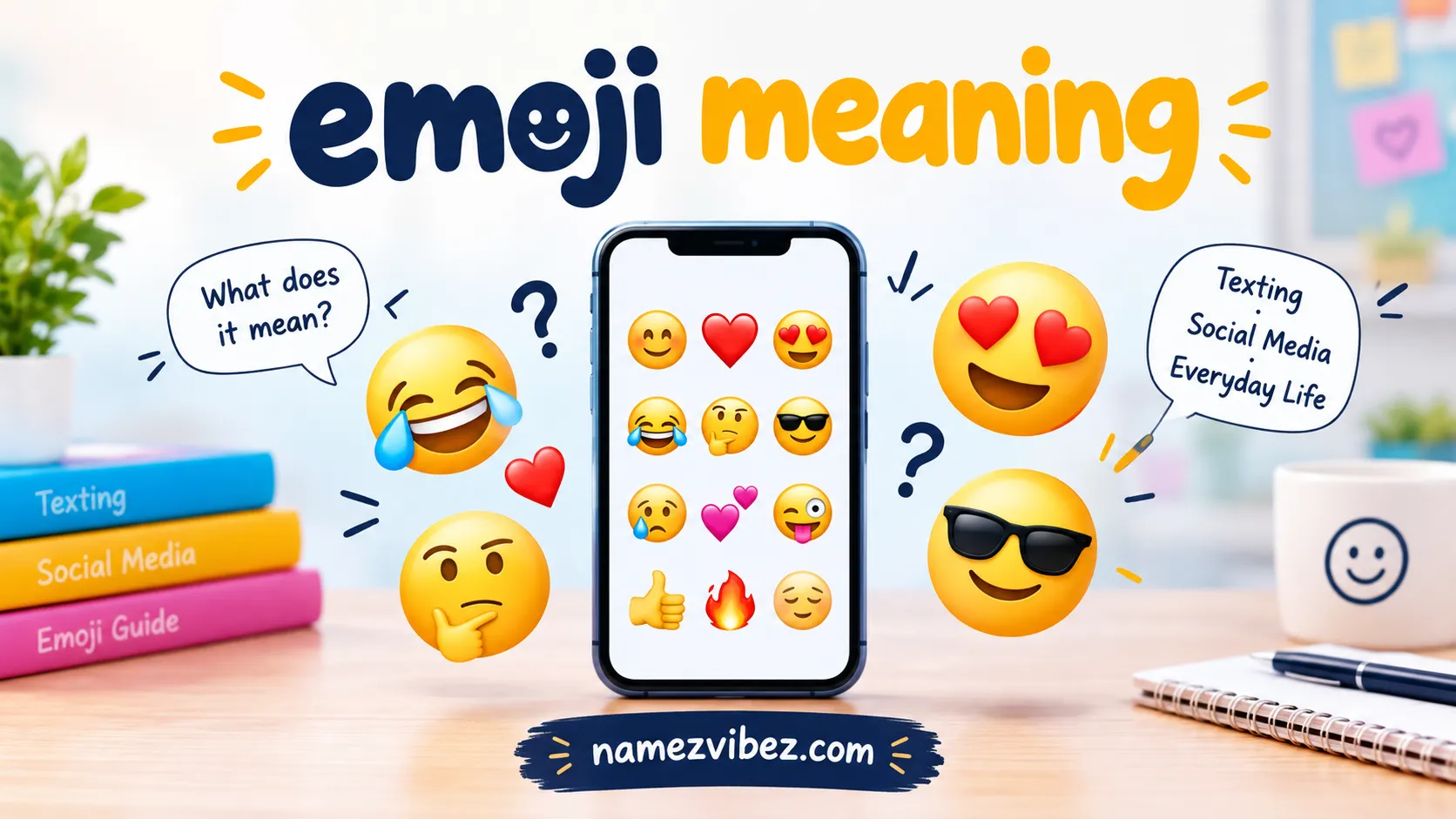
Have you ever received a message with just an emoji and wondered, “Wait, what does that actually mean?”
I remember seeing a simple emoji in a chat and spending more time thinking about its meaning than the message itself.
The funny thing is that emojis can change depending on the conversation, relationship, and even the platform where you see them.
A smile can show happiness, kindness, sarcasm, or awkwardness. That is why understanding emoji meaning can make texting much easier.
If you use emojis on WhatsApp, Snapchat, TikTok, Instagram, or regular text messages, knowing their common meanings helps you communicate your feelings more clearly.
Quick Answer:
Emoji meaning refers to the meaning or emotion an emoji expresses. It is a casual and friendly way to add feelings, reactions, or context to digital conversations.
What Does Emoji Meaning Mean in Text?
Emoji meaning is the emotion, idea, reaction, or message represented by a particular emoji. Emojis are small digital symbols that people use in texts and social media to express feelings without writing everything in words.
For example, 😊 usually represents happiness, friendliness, or warmth. If someone texts, “thanks for helping me 😊,” the emoji makes the message feel more friendly and appreciative.
However, an emoji can have different meanings depending on the situation. A 😂 emoji may simply mean that something is very funny, while ❤️ can express love, appreciation, or strong affection.
In short: Emoji meaning = the emotion or idea represented by an emoji = a visual way to add meaning to digital messages.
Where Is Emoji Meaning Commonly Used?
Emojis are popular almost everywhere people communicate online. You can find them in casual conversations, comments, captions, gaming chats, and even professional messages.
- 📱 Texting: Used to show emotions and reactions.
- 💬 WhatsApp: Commonly used to make conversations warmer.
- 👻 Snapchat: Often used with short, casual messages.
- 🎵 TikTok: Used in comments, captions, and reactions.
- 📸 Instagram: Popular in captions, comments, bios, and DMs.
- 🎮 Gaming Chats: Used for quick reactions and jokes.
- 💻 Online Chats: Helpful when plain text feels too serious.
Most emojis are casual and social-media-friendly. Some can work in professional conversations too, but their use should depend on the relationship and situation.
Examples of Emoji Meaning in Conversation
Here are some realistic examples showing how emojis can change the tone of a message.
Example 1
A: i finally finished my assignment 😭
B: omg congrats 😂
Here, 😭 can express being overwhelmed, exhausted, or dramatically emotional rather than literally crying.
Example 2
A: thank you so much ❤️
B: anytime!
The ❤️ adds warmth and appreciation.
Example 3
A: wanna grab coffee later? ☕
B: yes! 😊
The 😊 makes the reply sound friendly and positive.
Example 4
A: you really did that? 😂
B: yep 😭
Here, 😂 suggests strong amusement, while 😭 adds dramatic humor.
Example 5
A: goodnight 🌙
B: sleep well 😊
The emojis make the conversation feel softer and more friendly.
Example 6
A: i miss you 🥺
B: i miss you too ❤️
The 🥺 can express sadness, affection, or a pleading emotional tone.
Example 7
A: okayyy 👀
B: what? 😂
The 👀 emoji can suggest curiosity, interest, surprise, or that someone is paying close attention.
When to Use and When Not to Use Emoji Meaning
✅ When To Use Emojis
Emojis are useful when you want to:
- 😊 Make a friendly message warmer.
- 😂 Show that you are joking.
- ❤️ Express affection or appreciation.
- 🎉 Celebrate good news.
- 😭 Add dramatic humor.
- 👀 Show curiosity or interest.
- 👍 Give a quick reaction.
- 💬 Make casual conversations feel natural.
❌ When Not To Use Emojis
Be more careful with emojis when:
- 📧 Writing a very formal email.
- 💼 Communicating in a serious professional setting.
- 🚨 Discussing an urgent or sensitive issue.
- 📄 Writing official documents.
- ⚖️ Communicating about legal or formal matters.
- 🤝 You are unsure how the other person may interpret the emoji.
The same emoji can feel completely different depending on the person and context.
Emoji Usage Comparison
| Context | Example Phrase | Why It Works |
| Friend Chat | “no worries 😊” | Casual & friendly |
| Work Chat | “Thanks for the update.” | Polite & professional |
| Social Media | “this is so cute 🥹” | Expressive & casual |
| “Thank you for your help.” | Formal & clear | |
| Family Chat | “see you soon ❤️” | Warm & personal |
Similar Slang Words or Alternatives
Emoji meanings do not have exact slang replacements, but people often use words or text expressions to communicate the same feelings.
| Slang/Expression | Meaning | When to Use |
| LOL | Laughing | Funny or casual chats |
| OMG | Strong surprise | Exciting or shocking moments |
| Haha | Amusement | Friendly conversations |
| Aww | Affection or sweetness | Cute or emotional moments |
| Yay | Happiness or celebration | Good news |
| Hmm | Thinking or uncertainty | When considering something |
These expressions can work alongside emojis. For example, “omg 😂” combines text slang with an emoji to make the reaction stronger.
Why Can One Emoji Have Different Meanings?
One reason emoji meanings can be confusing is that people do not always use emojis literally.
For example, 😂 traditionally represents laughing with tears, but people may use it simply to say that something is extremely funny. Similarly, 😭 traditionally represents crying, but younger internet users may use it to show laughter, embarrassment, excitement, or emotional overwhelm.
Relationship and context also matter.
If a close friend sends ❤️, it may simply mean affection or appreciation. If someone sends the same emoji in a romantic conversation, it may carry a more affectionate meaning.
The words around the emoji are therefore important.
Can Emoji Meanings Change on Social Media?
Yes. Emoji usage can change as online trends develop. TikTok, Instagram, Snapchat, and other platforms can influence how people use particular emojis.
Some emojis may develop humorous, ironic, sarcastic, or community-specific meanings. This means the standard dictionary meaning is not always the meaning intended in a particular conversation.
For example, someone may use 💀 to mean that something is extremely funny. They are not necessarily talking about death. Likewise, 😭 can sometimes mean “this is so funny” rather than actual sadness.
Understanding the surrounding message is the best way to interpret an emoji.
Are Emojis Casual or Formal?
Most emojis are casual. They are especially common among friends, family members, couples, and social-media users.
Some simple emojis can also appear in workplace communication, especially in relaxed teams. However, it is safer to understand the communication style of the person or organization before using them.
For example:
- Casual: “great job! 🎉”
- Friendly work chat: “thanks for helping 😊”
- Formal email: “Thank you for your assistance.”
When communication needs to be precise and professional, clear words are usually better than relying heavily on emojis.
FAQs
1. What does emoji meaning mean?
Emoji meaning refers to the emotion, reaction, idea, or message represented by an emoji.
2. Why do people use emojis?
People use emojis to express emotions, reactions, humor, affection, and tone quickly.
3. Can one emoji have multiple meanings?
Yes. An emoji can have different meanings depending on context, relationship, platform, and current online usage.
4. What does 😊 mean?
😊 commonly represents happiness, friendliness, kindness, or warmth.
5. What does ❤️ mean?
❤️ commonly represents love, affection, appreciation, or strong positive feelings.
6. What does 😂 mean?
😂 commonly represents strong laughter or amusement.
7. What does 😭 mean in texting?
😭 can represent sadness, but it is also frequently used online for dramatic humor, laughter, frustration, or being emotionally overwhelmed.
8. What does 👀 mean in text?
👀 can indicate curiosity, interest, attention, surprise, or watching something closely.
9. Are emojis slang?
Emojis are not exactly slang, but people can use them as informal expressions or give them slang-like meanings in online conversations.
10. Are emojis appropriate at work?
It depends on the workplace and the relationship. Simple emojis may be acceptable in casual team chats, while formal emails may be better without them.
11. Do emojis have the same meaning everywhere?
Not always. Cultural differences, platforms, age groups, and online communities can influence emoji interpretation.
12. Can emojis be sarcastic?
Yes. People sometimes use emojis sarcastically, especially when the literal meaning does not match the surrounding text.
13. What does 💀 mean in texting?
💀 can literally represent a skull, but online it is often used humorously to mean something is extremely funny or shocking.
14. Can emojis make messages friendlier?
Yes. Emojis can make short messages feel warmer and less serious when used appropriately.
15. Can emojis cause misunderstandings?
Yes. Since emojis can have multiple interpretations, a person may understand an emoji differently from the sender.
16. Are emojis used on Instagram?
Yes. Emojis are commonly used in Instagram captions, comments, direct messages, and bios.
17. Are emojis popular on Snapchat?
Yes. Snapchat users frequently use emojis in messages, captions, and reactions.
18. Can emojis replace words?
Sometimes. A single emoji can communicate a simple reaction, but words are better when a message needs to be detailed or precise.
19. How can I understand an unfamiliar emoji?
Look at the surrounding message, the conversation topic, and how the sender normally communicates. These clues can help explain the intended meaning.
20. Why is understanding emoji meaning important?
Understanding emoji meaning can help you interpret online conversations more accurately and choose emojis that communicate your intended emotion.
Conclusion:
Emojis may look simple, but their meanings can depend heavily on context.
When you understand the common meaning and the situation around an emoji, you can make your texts, comments, and social-media conversations much clearer and more expressive.

I am writing about Rick Riordan, a famous American author best known for creating the popular Percy Jackson & the Olympians series. I am highlighting his talent for combining mythology with modern storytelling, which has made his books loved by millions of readers around the world. On namezvibez.com, I am exploring his creative writing style, bestselling novels, and the impact he has had on young readers and fantasy literature.