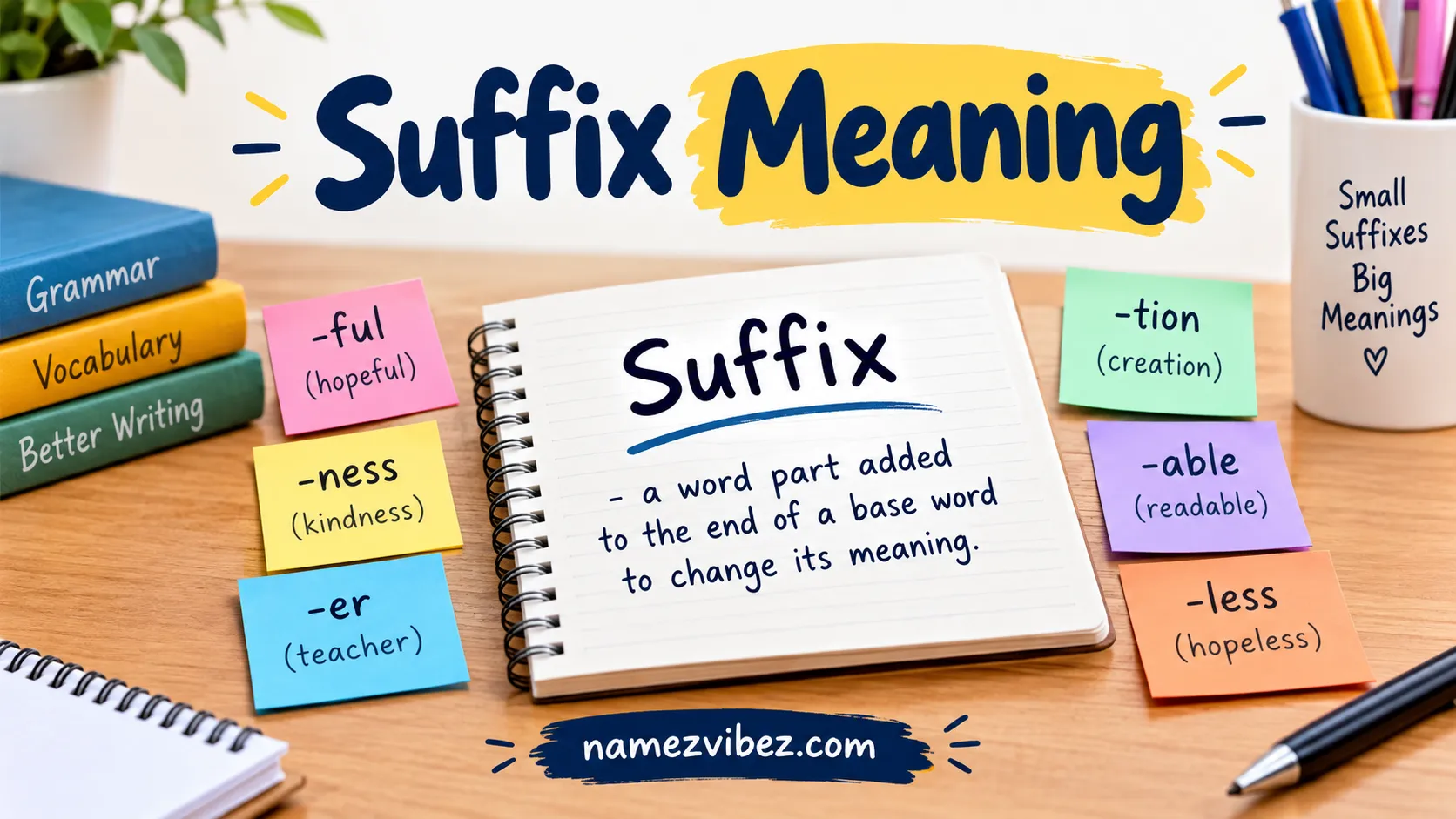
I first came across the word “suffix” while trying to understand how new words are formed. I knew that some words could change their meaning when letters were added, but I was not sure what those added letters were called.
After looking into it, I learned that a suffix is simply a group of letters added to the end of a word. It can change the word’s meaning, form, or grammatical role.
Once I understood this, words like “helpful,” “happiness,” and “quickly” became much easier to understand.
Quick Answer: Suffix means “a group of letters added to the end of a word.” It is a common grammar term used to explain how words are changed or formed.
🧠 What Does Suffix Mean in Text?
A suffix is a letter or group of letters placed at the end of a word to change its meaning, grammatical function, or word form.
For example:
- help + ful = helpful
- happy + ness = happiness
- quick + ly = quickly
- teach + er = teacher
In these examples, -ful, -ness, -ly, and -er are suffixes.
Some suffixes create a completely different type of word. For example, adding -er to “teach” creates “teacher,” which changes a verb into a noun. Adding -ly to “quick” creates “quickly,” which commonly changes an adjective into an adverb.
In short: Suffix = letters added to the end of a word = a way to form or modify words.
📱 Where Is “Suffix” Commonly Used?
The word suffix is not really texting slang. It is a standard English-language and grammar term.
You may see it in these places:
- 📚 School: English and grammar lessons often teach prefixes and suffixes.
- ✍️ Writing: Writers use words containing suffixes all the time.
- 📖 Dictionaries: Word definitions may explain how suffixes affect word forms.
- 💻 Online learning: Students commonly search for suffix meanings and examples.
- 🧠 Language study: Suffixes are important when learning how English words are built.
- 📝 Grammar exercises: Teachers may ask students to identify the suffix in a word.
The word suffix itself is generally formal and educational, rather than casual, flirty, or social-media slang.
💬 Examples of “Suffix” in Conversation
Here are realistic examples of how people might use the word suffix in everyday or educational conversations:
A: what does the suffix “-less” mean?
B: it usually means “without,” like “careless” or “hopeless.”
A: is “-ly” a suffix?
B: yep! it’s added to the end of words like “slowly.” 😊
A: what’s the suffix in “happiness”?
B: “-ness” is the suffix.
A: i have a grammar test tomorrow 😭
B: don’t worry, just remember that a suffix comes at the end of a word.
A: is “teacher” made with a suffix?
B: yes! “-er” is added to “teach.”
A: what’s the difference between a prefix and suffix?
B: a prefix goes at the beginning, while a suffix goes at the end.
A: this suffix stuff is actually easier than i thought 😂
B: right? once you know the pattern, it gets simple.
🕓 When to Use and When Not to Use “Suffix”
✅ When To Use
Use the word suffix when:
- 📚 Talking about English grammar.
- ✍️ Explaining how words are formed.
- 🎓 Helping someone with homework.
- 🔤 Discussing prefixes, roots, and word endings.
- 📖 Explaining the structure of a word.
- 🧠 Studying vocabulary or linguistics.
❌ When Not To Use
Avoid using suffix when:
- 💬 You simply want to describe the end of a casual message.
- 📱 You are talking about texting abbreviations rather than word structure.
- 🚨 A simple everyday explanation would be clearer without technical grammar terms.
- 📨 You are writing a formal message and the person may not understand grammar terminology.
| Context | Example Phrase | Why It Works |
| Friend Chat | “what’s the suffix here? 😄” | Casual grammar discussion |
| Work Chat | “The ending is a suffix.” | Clear and professional |
| “The suffix changes the form of the word.” | Formal and precise | |
| School | “Identify the suffix in each word.” | Common educational usage |
| Social Media | “Did you know ‘-ness’ is a suffix?” | Educational and easy to understand |
🔄 Similar Grammar Terms or Alternatives
| Term | Meaning | When to Use |
| Prefix | Letters added to the beginning of a word | When discussing word beginnings |
| Root word | The basic part of a word | When explaining word structure |
| Word ending | The part that appears at the end | Simple everyday explanation |
| Affix | A linguistic element added to a word | More technical grammar discussions |
| Inflection | A word change showing grammatical information | Grammar and linguistics |
| Word formation | The process of creating or changing words | Broader language discussions |
A prefix and a suffix are both types of affixes. The key difference is their position: a prefix comes before the root or base, while a suffix comes after it.
❓ FAQs
1. What does suffix mean?
A suffix is a letter or group of letters added to the end of a word.
2. What is an example of a suffix?
In the word “kindness,” the letters “-ness” are the suffix.
3. What is the opposite of a suffix?
A prefix is commonly contrasted with a suffix because it is placed at the beginning of a word.
4. Is “-ing” a suffix?
Yes. In words such as “running” and “reading,” “-ing” functions as a suffix.
5. Is “-ed” a suffix?
Yes. “-ed” is commonly used as a suffix to form past-tense or past-participle forms of many English verbs.
6. What is the suffix in “happiness”?
The suffix is “-ness.”
7. What is the suffix in “teacher”?
The suffix is “-er.”
8. What is the suffix in “quickly”?
The suffix is “-ly.”
9. Can a suffix change a word’s meaning?
Yes. For example, adding “-less” to “hope” creates “hopeless,” changing the meaning.
10. Can a suffix change a word’s part of speech?
Yes. For example, “happy” becomes “happiness,” changing an adjective into a noun.
11. Is a suffix always one letter?
No. A suffix can contain one letter or several letters, such as “-s,” “-ed,” “-ful,” “-ness,” or “-ment.”
12. Is “s” a suffix?
It can be. In words such as “cats,” the “-s” can function as a grammatical suffix marking the plural.
13. Is “ly” a suffix?
Yes. “-ly” is a common English suffix, especially in words such as “slowly,” “quickly,” and “carefully.”
14. Is suffix a grammar word?
Yes. Suffix is a standard term used in grammar and linguistics.
15. What is the difference between a suffix and an ending?
A suffix is a specific linguistic element added to a word, while “ending” is a broader and less technical term.
16. Is a suffix the same as a root word?
No. A root or base provides the central part of a word, while a suffix is added to it.
17. Can suffixes make new words?
Yes. Suffixes are frequently used to create new words or different forms of existing words.
18. Are suffixes used only in English?
No. Many languages use suffixes as part of their word-building or grammatical systems.
19. Are suffixes used in texting?
Suffixes are part of normal words used in texting, but “suffix” itself is not a common texting abbreviation or slang term.
20. What is the easiest way to remember suffix meaning?
Remember this simple rule: prefix = beginning, suffix = end. If letters are added to the end of a word, they may form a suffix.
🎯 Conclusion
Understanding the suffix meaning becomes easy once you remember one simple rule: a suffix comes at the end of a word.
Suffixes such as -ness, -ful, -ly, -er, and -less can change a word’s meaning, form, or grammatical role.
They are commonly used in English grammar, writing, and everyday vocabulary.
If you are learning prefixes and suffixes, focus on identifying where the added letters appear and how they change the original word. With a little practice, spotting suffixes in words can become quick and simple.

I am writing about Rick Riordan, a famous American author best known for creating the popular Percy Jackson & the Olympians series. I am highlighting his talent for combining mythology with modern storytelling, which has made his books loved by millions of readers around the world. On namezvibez.com, I am exploring his creative writing style, bestselling novels, and the impact he has had on young readers and fantasy literature.