
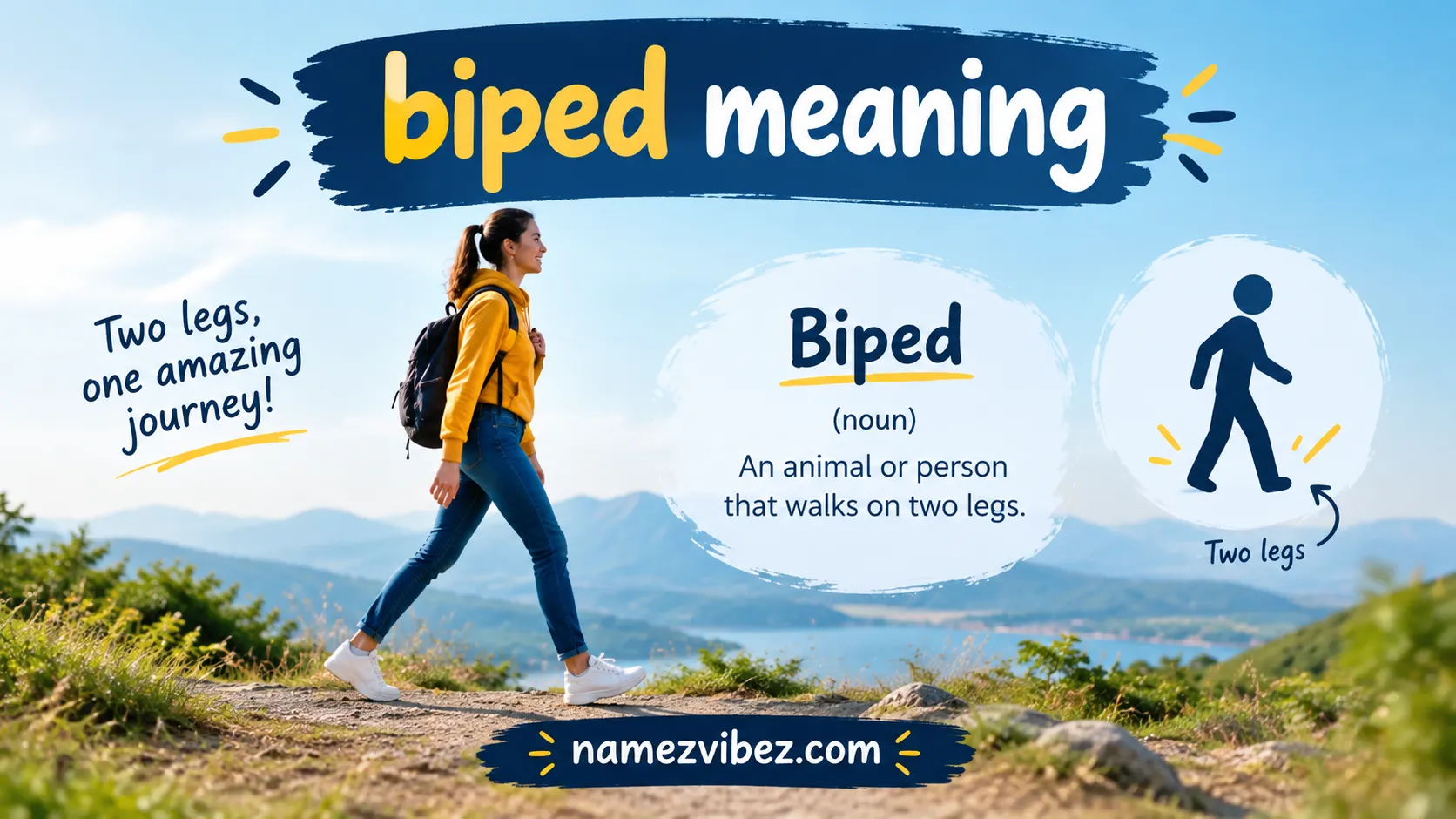
I was at the natural history museum with my nephew when he stopped in front of a towering dinosaur skeleton. “This label says biped, is that why it stands like a giant chicken?” he asked, delighted. I read the plaque twice and said, “I think it simply means the creature walked on two legs, like you do at football practice.” He marched in place and replied, “Then I am a biped too, and so is the penguin at the zoo.” I had to admit his science was sound. Here is the clear biped meaning we pieced together that afternoon, starting below.
🧠 What Does Biped Mean in Text?
The word biped comes from Latin roots related to having two feet. In simple terms, a biped is a creature that uses two legs for walking or standing.
Humans are naturally described as bipeds because we normally walk upright on two legs. Birds are also commonly considered bipeds because they move around using two legs.
For example:
“Humans are bipedal animals that usually walk upright.”
As a noun, biped means a two-legged creature. As an adjective, the related word bipedal describes something involving or relating to two-legged movement.
If someone uses “biped” in a text message, they may simply be talking about a human, animal, robot, or fictional creature with two legs. In gaming and online communities, it can sometimes be used humorously to describe a person.
In short: Biped = two-legged creature = a person or animal that walks on two legs.
📱 Where Is Biped Commonly Used?
Unlike texting abbreviations such as “LOL” or “BRB,” biped is not mainly internet slang. It is a normal English vocabulary word.
You may see it in different places, including:
- 🧬 Science and biology: Used when discussing animals and human movement.
- 📚 School or educational content: Common in lessons about anatomy and evolution.
- 🎮 Gaming chats: Sometimes used humorously for human characters, robots, or creatures.
- 💬 Texting: Can appear when someone is making a joke or discussing animals.
- 😂 Memes and social media: May be used as a funny way to refer to humans.
- 🤖 Technology and robotics: Used when discussing two-legged robots.
- 🐦 Animal discussions: Can describe birds and other two-legged animals.
Is “Biped” Formal or Casual?
The word biped is neutral, but it can sound somewhat scientific or technical in everyday conversation. Most people would simply say “person,” “human,” or “two-legged animal” instead.
For example, saying “That biped over there” can sound funny or intentionally robotic because it describes a person in an unusual way.
So, its tone depends on the context:
- Formal: Scientific or educational writing
- Neutral: General descriptions
- Casual: Possible in conversations
- Humorous: Common when referring to humans in an unusual way
- Flirty: Not normally flirty
💬 Examples of Biped in Conversation
Because biped is not a texting abbreviation, people generally use it as a normal vocabulary word. Here are some realistic examples:
A: what exactly is a biped?
B: basically, a creature that walks on two legs 😄
A: is a human a biped?
B: yep! humans are classic examples of bipeds.
A: that robot can actually walk like a human 🤖
B: yeah, it’s a pretty impressive biped.
A: why did the game call my character a biped? 😂
B: because your character walks on two legs lol
A: birds are bipeds too, right? 🐦
B: yes, most birds move around on two legs.
A: “biped” sounds like a sci-fi word 😂
B: haha, i thought the same thing when i first heard it.
A: the documentary keeps talking about bipedal movement
B: that just means movement using two legs.
These examples show that biped can fit naturally into casual chats when the conversation is about animals, humans, robots, science, or games.
🕓 When to Use and When Not to Use Biped
✅ When To Use “Biped”
You can use biped when:
- 🧬 Talking about biology or anatomy
- 🐾 Describing an animal that walks on two legs
- 🤖 Discussing two-legged robots
- 🎮 Talking about a game character
- 📚 Writing educational or scientific content
- 😂 Making a humorous comparison about humans
- 💬 Explaining the difference between two-legged and four-legged creatures
❌ When Not To Use “Biped”
Avoid using biped when:
- You simply mean “person” in a normal conversation.
- You are writing a very simple message for someone unfamiliar with the word.
- The situation requires warm or natural language.
- You are writing a formal email where “person” or “human” would be clearer.
- You are trying to use it as texting slang or an abbreviation.
For example, instead of saying “Please ask the biped to call me,” a normal message would be “Please ask the person to call me.”
Biped vs. Everyday Alternatives
Friend Chat: “that biped just stole my seat 😂” – Funny and playful. Science Chat: “humans are bipedal.” – Accurate and descriptive. Work Chat: “Please ask the person to contact me.” – Clear and professional. Email: “Humans are bipedal mammals.” – Formal and precise. Gaming Chat: “that biped character is so fast 😂” – Casual and humorous.
🔄 Similar Slang Words or Alternatives
Although biped does not have an exact slang equivalent, several words can communicate a similar idea depending on the situation.
Human: A person or member of the human species – Everyday conversations. Person: An individual human – General and professional use. Two-legged: Having two legs – Simple descriptions. Bipedal: Relating to movement on two legs – Science and biology. Creature: A living being or animal – Casual or descriptive contexts. Hominid: A member of the human family – Scientific or historical discussions.
The best alternative depends on what you are trying to say. “Person” sounds the most natural in everyday communication, while “biped” is more specific and descriptive.
💬 Funny Replies When Someone Calls You Biped
Not sure what to text back? Copy and paste one of these natural replies.
- Ha, good one.
- Very funny.
- Okay, that got me.
- Nice joke.
- LOL, true.
📜 Where Did Biped Slang Come From?
Biped is a biology term for two-legged creatures. As slang it became a playful insult in gaming and meme culture, where calling someone a biped teases them for stating the obvious or acting basic.
Have you ever come across the word biped in a message, game, comment, or online discussion and wondered what it meant? The word looks short and unusual, so many people assume it is some kind of internet abbreviation. In reality, biped is a regular English word with a simple meaning: a person or animal that walks on two legs. Humans are the most familiar examples of bipeds, and birds are another common one. The word shows up in science, biology, gaming, jokes, robotics, and casual online conversations, and this guide explains every angle of it in plain language.
Quick answer: Biped means a two-legged or two-footed person or animal. It is a neutral word used in scientific, educational, descriptive, and sometimes humorous contexts.
What Does Biped Mean in Text and Everyday Language
The word biped comes from Latin roots related to having two feet. In simple terms, a biped is a creature that uses two legs for walking or standing. Humans are naturally described as bipeds because we normally walk upright on two legs. Birds are also commonly considered bipeds because they move around using two legs.
As a noun, biped means a two-legged creature. As an adjective, the related word bipedal describes something involving or relating to two-legged movement. If someone uses biped in a text message, they may simply be talking about a human, animal, robot, or fictional creature with two legs. In gaming and online communities, it is sometimes used humorously to describe a person, as in calling a friend a biped to sound playfully robotic.
In short: biped equals a two-legged creature, a person or animal that walks on two legs.
How to Pronounce Biped
Say it as BYE-ped, two syllables. The first syllable rhymes with bye and my, and the second syllable rhymes with bed. Put the stress on the first syllable: BYE-ped, never bye-PED. In dictionaries the pronunciation is written with phonetic symbols that look like bye-ped, which matches how it sounds.
The plural is bipeds, pronounced BYE-pedz. The adjective bipedal is pronounced bye-PED-al, with the stress on the middle syllable. Try it in a sentence: Humans are bipeds that walk upright. Say it a few times and it will feel completely natural.
Where the Word Biped Comes From
Biped comes from Latin: bi meaning two, and pes meaning foot, with the stem ped meaning of the foot. Put together, the word literally means two-footed. It has been used in English since the 1600s, mainly in zoology and natural history writing.
You can see the same Latin roots in everyday words. A pedal is worked with the foot, a pedestrian travels on foot, and a pedestal is the foot of a statue. Once you spot the ped root, the meaning of biped becomes obvious and easy to remember.
Biped, Bipedal, and Bipedalism: The Word Family
These three related words are often mixed up. Here is how they differ:
- Biped (noun): a two-legged creature. Example: An ostrich is a large biped.
- Bipedal (adjective): relating to two-legged movement. Example: Humans are bipedal animals.
- Bipedalism (noun): the practice or condition of walking on two legs. Example: Scientists study the evolution of bipedalism.
- Bipedally (adverb): in a two-legged manner. Example: The robot moves bipedally across the room.
- Quadruped (noun): the opposite, a four-legged animal. Example: A horse is a quadruped.
Obligate vs Facultative Bipeds: The Biology Behind the Word
Biologists divide bipeds into two groups, and this distinction is where the word gets genuinely interesting. Obligate bipeds are animals whose normal, default way of getting around is on two legs. Humans, most birds, and kangaroos belong here. Their bodies are built for it, from hip structure to balance systems.
Facultative bipeds normally move on four or more limbs but switch to two legs in certain situations. Chimpanzees stand upright to reach fruit. Bears rear up to look around or threaten a rival. Several lizard species run on their hind legs at high speed because the forward shift in their center of mass lifts the front end off the ground. The basilisk lizard takes this further and runs bipedally across the surface of water, which earned it the nickname the Jesus Christ lizard. Even cockroaches rear up onto their hind legs at their fastest running speeds.
So bipedalism is not one thing with one cause. It is a locomotor strategy that has evolved independently many times, in many animal families, for many different reasons.
Real-World Examples of Bipeds
Bipeds are everywhere once you start looking. Here are the most important examples, from everyday life to deep history:
- Humans: the only mammals that walk upright on two legs at all times, the classic example
- Ostriches: among the fastest living bipeds, reaching speeds around 70 kilometers per hour
- Kangaroos: move by hopping on two powerful hind legs, with the tail as a third support
- Penguins: waddle upright on two legs on land and swim with flippers in water
- Chickens and songbirds: most birds are obligate bipeds, from sparrows to eagles
- Tyrannosaurus rex: the famous dinosaurs were bipeds, and all birds descend from bipedal theropod dinosaurs
- Chimpanzees: facultative bipeds that walk upright briefly, usually while carrying food
- Basilisk lizards: run on two hind legs, even across water
- Bipedal robots: humanoid machines built to walk like people, used in research and industry
- Meerkats: stand upright on two legs to scan for danger, then drop back to four
Biped in Science, School, and Research
In biology and anatomy, biped is a standard descriptive term for classifying how animals move. In evolutionary science, the shift to bipedalism is one of the defining events in human history, freeing the hands for tool use. In biomechanics, researchers study the balance, muscle coordination, and skeletal alignment that make upright walking possible. In robotics, engineers chase the same problem: teaching a two-legged machine to walk without falling over. Students meet the word in lessons about the animal kingdom, where animals are grouped by how many limbs they use for movement.
Biped in Texting, Gaming, and Memes
Unlike abbreviations such as LOL or BRB, biped is not internet slang. It is a normal vocabulary word that sometimes appears in chats for humor or description. In gaming, it can describe a humanoid character or be used jokingly for another player. In memes, calling humans bipeds is a running joke that makes ordinary people sound like specimens under observation. A classic version is the old philosophical joke that defined humans as featherless bipeds, which is still quoted for laughs today. In texting, someone might write it when discussing animals, robots, or science, or simply to sound deliberately technical for comic effect.
Biped vs Similar Words
Here is how biped compares with words people often confuse it with:
- Biped vs quadruped: two legs versus four legs, the direct opposite
- Biped vs bipedal: the creature versus the description of its movement
- Biped vs human: all humans are bipeds, but not all bipeds are humans
- Biped vs hominid: hominid refers to the human family tree, biped refers only to leg count
- Biped vs two-legged: same meaning, but two-legged sounds simpler and more casual
When to Use Biped and When to Avoid It
Use biped when talking about biology or anatomy, describing an animal that walks on two legs, discussing two-legged robots, talking about a game character, writing educational or scientific content, making a humorous comparison about humans, or explaining the difference between two-legged and four-legged creatures.
Avoid it when you simply mean person in a normal conversation, when writing a very simple message for someone unfamiliar with the word, when the situation needs warm or natural language, when writing a formal email where person or human would be clearer, or when trying to use it as texting slang or an abbreviation. Saying Please ask the biped to call me sounds strange; Please ask the person to call me is what you want.
Common Mistakes With Biped
The most common mistake is using biped where bipedal belongs. Say Humans are bipeds or Humans are bipedal, not Humans are biped animals. Another mistake is assuming it is slang or an abbreviation; it is standard English with centuries of history. People also misplace the stress, saying bye-PED instead of BYE-ped. Finally, some writers use it to sound clever in everyday messages, where it usually just sounds odd. Save it for contexts where the two-legged meaning actually matters.
Biped in Other Languages
The word travels well because the Latin roots are shared across many languages:
- Spanish: bipedo
- French: bipede
- German: Zweibeiner
- Italian: bipede
- Portuguese: bipede
- Hindi: dwipad
- Arabic: thunai al arjul, meaning two-legged
- Chinese: shuang zu dongwu, meaning two-footed animal
- Japanese: nisoku hokou doubutsu, meaning bipedal walking animal
What does biped mean?
Biped means a person or animal that has or uses two legs for walking. The word comes from Latin bi meaning two and pes meaning foot.
Is biped a slang word?
No. Biped is a standard English word with centuries of history, not a texting abbreviation or slang term. It only sounds like slang because it is uncommon in everyday chat.
Is a human a biped?
Yes. Humans are the classic example of obligate bipeds, animals that walk upright on two legs as their normal way of moving.
What is the difference between biped and bipedal?
Biped is a noun naming the creature, while bipedal is an adjective describing the movement. An ostrich is a biped; its way of running is bipedal.
What is the opposite of biped?
The direct opposite is quadruped, an animal that walks on four legs, such as a horse, dog, or cat.
Can I use biped in a formal essay?
Yes. It fits well in essays about biology, anatomy, evolution, animals, robotics, or human movement. Just make sure the two-legged meaning is relevant to your point.
Biped Body Plans: Why Two Legs Change Everything
Walking on two legs is not just a different way to move. It reshapes the whole body. Hips narrow and steady the stride, knees lock to save energy, feet arch to spring forward, and the spine curves so the head sits balanced on top. Each change trades something away. A biped gains height, a wider view, and free hands, but it gives up the raw speed and stability that four legs provide. That trade is why the word matters in science. It names a full body plan, not just a leg count.
Look at three very different bipeds and the same pattern appears. A human walks upright all day because the skeleton is stacked for balance. An ostrich runs fast because long legs and strong tendons store energy with every stride. A penguin waddles on land because its body is built for swimming, yet two legs still carry it to its nesting ground. The details differ, but the bargain is the same. Two legs free the rest of the body to do other work, whether that work is carrying food, holding tools, or keeping watch.
Robots show the same bargain in a clearer way. Engineers could give a machine four legs and an easy, stable walk. They choose two legs when the machine must climb stairs, step over obstacles, or work in spaces built for people. The cost is constant balancing work, and the reward is access to a human shaped world. Next time you hear the word biped, picture that whole bargain. It is a story about balance, energy, and hands set free.
Biped Quiz: Test What You Remember
Try these quick questions before you move on. Answers follow each question so you can check yourself right away.
Question 1: Is a penguin a biped? Yes. Penguins walk upright on two legs on land, even though they swim with flippers in water.
Question 2: What is the adjective form of biped? Bipedal. Use it to describe movement, as in bipedal walking, not to name the creature itself.
Question 3: Is a bear an obligate biped? No. Bears are facultative bipeds. They usually move on four legs and stand upright only for short moments.
Question 4: Where does the word come from? Latin bi meaning two, plus pes meaning foot. Put together, the word literally means two-footed.
Question 5: When should you avoid the word in a message? Avoid it when you simply mean person in a normal chat, or when plain language would be warmer and clearer.
If you answered most of these correctly, you have the word down. If one tripped you up, reread the section on obligate and facultative bipeds, since that distinction is the part most readers mix up.
Conclusion
The word biped may look like internet slang when you first encounter it, but it is actually a standard English term with deep Latin roots and real scientific weight. It describes a creature that walks on two legs, from humans and ostriches to kangaroos, dinosaurs, and humanoid robots. In everyday texting, person or human will usually sound more natural, but biped is the right word whenever the two-legged detail matters. The next time you see it in a game, meme, or conversation, you will know exactly what it means, how to say it, and where it came from.
❓ FAQs
1. What does biped mean?
Biped means a person or animal that has or uses two legs for walking.
2. Is biped a slang word?
No. Biped is a standard English word, not a common texting abbreviation or slang term.
3. What does biped mean in text?
In a text, biped generally has its normal meaning: a two-legged creature, usually a human or animal.
4. Is a human a biped?
Yes. Humans are commonly classified as bipedal animals because they normally walk upright on two legs.
5. Are birds bipeds?
Yes. Birds are generally considered bipedal animals because they use two legs for walking and standing.
6. What is the adjective form of biped?
The adjective form is bipedal, meaning related to or involving two-legged movement.
7. Is biped formal?
It can sound somewhat technical or scientific, although it is not exclusively formal.
8. Is biped used on social media?
It can appear on social media, especially in memes, gaming discussions, science posts, and humorous comments.
9. Is biped used on Snapchat?
It may appear on Snapchat, but it is not a common Snapchat abbreviation.
10. Is biped used on TikTok?
Yes, someone could use the word on TikTok, particularly in educational, gaming, science, or humorous content.
11. Can biped describe a robot?
Yes. A robot designed to walk on two legs can be described as a bipedal robot or simply a biped.
12. What is the opposite of biped?
A direct everyday contrast would be a quadruped, which refers to an animal that uses four legs for walking.
13. What is a bipedal animal?
A bipedal animal is an animal that uses two legs for locomotion.
14. Is biped the same as bipedal?
Not exactly. Biped can be a noun referring to a two-legged creature, while bipedal is an adjective describing two-legged movement or anatomy.
15. Can I use biped to describe a person?
Yes, but it may sound unusual or humorous in everyday conversation.
16. Does biped mean human?
Not specifically. Humans are bipeds, but other two-legged animals can also be described as bipeds.
17. Is biped a positive or negative word?
It is generally neutral. The tone depends on how someone uses it.
18. Is biped flirty?
No. Biped has no standard flirty meaning. If someone uses it jokingly in a conversation, the humor comes from the context.
19. Can biped be used in a formal essay?
Yes. It can be useful in essays about biology, anatomy, evolution, animals, robotics, or human movement.
20. What is the easiest way to understand biped?
The simplest definition is: a creature that walks on two legs.
Biped Meaning in Sports and Everyday Movement
Sports show the power of two legged movement better than any textbook, because athletes run, jump, and balance on two legs every single day. A sprinter pushes off the ground with one foot at a time, a footballer changes direction in a split second, and a gymnast lands a flip on two steady feet. These examples help students understand why biped is not just a science word but a description of how most of us move through life. Coaches also use the idea of two legged balance when they teach posture, because a strong stance begins with feet placed well. Learning the word through sport makes it easy to remember, and it turns a classroom definition into something you can feel in your own body.
- A sprinter shows bipedal speed when both legs work in a fast and smooth rhythm.
- A goalkeeper shows bipedal balance when diving sideways and landing on two feet.
- A dancer shows bipedal grace when spinning on two legs without falling.
- A hiker shows bipedal endurance when climbing a mountain step by step.
- A child learning to walk shows the first bipedal steps every parent celebrates.
- A yoga student shows bipedal control when standing tall on two feet.
- A basketball player shows bipedal power when jumping for a rebound.
- A marching band member shows bipedal timing when stepping in perfect unison.
Biped in Cartoons, Games, and Robot Characters
Cartoons, games, and robots love biped characters, because a two legged hero feels familiar even when it comes from another planet. A cartoon bird that walks upright, a game robot that runs on two legs, and a movie alien with human like steps all use the biped idea to connect with the audience. Game designers choose biped characters when they want players to feel the movement in their own bodies, since jumping and running feel natural on two legs. Robot builders also copy biped movement, because a robot that walks like a person can climb stairs and open doors more easily. These fun examples make the word biped easy to spot in everyday entertainment, and they show that science words hide in the stories we love most.
- Cartoon penguins walk upright like tiny bipeds in funny waddling steps.
- Game robots run on two legs so players can jump and climb naturally.
- Movie aliens often walk on two legs to feel familiar to human viewers.
- Toy robots with two legs teach children about balance and movement.
- Animated dinosaurs in family films often stand on two legs for comedy.
- Video game heroes run, jump, and crouch using biped movement.
- Robot pets with two legs can follow their owners up and down stairs.
- Science fiction androids copy human walking to blend into crowds.
Quick Questions About Biped Meaning
Is every animal that stands on two legs a biped? Mostly yes, because the word describes how an animal moves, not how it looks. Birds, humans, and kangaroos are classic bipeds, while an animal that only stands briefly on two legs, such as a dog begging for food, is not usually called a biped. Can biped be used as an insult in texting? Sometimes, because calling someone a biped in a game chat is a playful way to say they are just a normal human, not a special creature. The tone depends on context, so a joke between friends feels friendly, while the same word from a stranger may feel rude.
Conclusion:
The word biped may look like internet slang when you first encounter it, but it is actually a standard English term.
It describes a creature that has or uses two legs, with humans and birds being familiar examples.
In everyday texting, “person” or “human” will usually sound more natural. However, biped can be useful when you want to sound scientific, descriptive, playful, or humorous.
If you see it in a game, meme, social-media post, or conversation, simply think “two-legged creature.”

I am a fan of famous American author James Patterson and I love sharing interesting information about him on my website namezvibez.com. I am inspired by his incredible storytelling and the many bestselling books he has written. I am creating content to help readers quickly learn about his life, career, and achievements in a simple and engaging way. On namezvibez.com, I share short and useful details about popular authors and personalities. ✍️📚