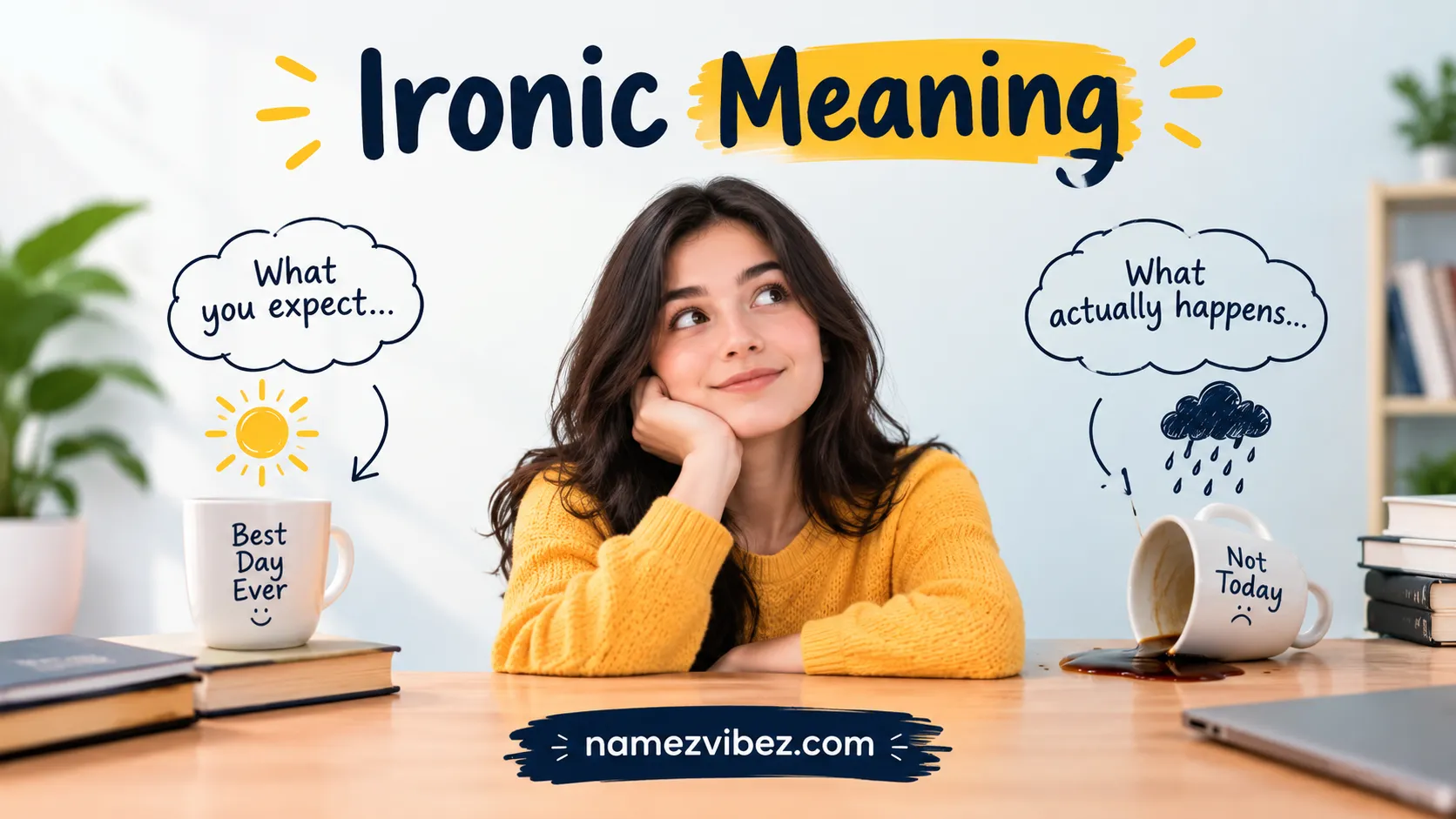
I was standing under a shop awning with my friend Theo while rain poured down on our picnic plans. “Perfect beach weather, truly ironic,” he said, wringing out his cap. I watched a duck glide across a puddle and replied, “I use that word all the time, but I suspect I use it wrong half the time.” Theo grinned and said, “Most people do, it is about the gap between expectation and reality.” I thought about every rained out plan and broken umbrella I had ever owned. Here is the ironic meaning explained the way Theo framed it, starting with the clear definition below.
🧠 What Does Ironic Mean in Text?
The word ironic describes a situation where the result is very different from what you would normally expect. It often points out a funny, surprising, or meaningful contrast.
For example, imagine someone who always tells friends to be on time arriving one hour late. You might say, “That’s ironic!”
In texting, people may use ironic to react to situations that seem almost backwards or unexpectedly opposite.
Example:
“I told everyone not to forget their umbrellas, and then I forgot mine. So ironic 😂”
In short: Ironic = an unexpected contrast = something happening differently from what you expect.
📱 Where Is Ironic Commonly Used?
You can see ironic in many online and everyday conversations:
- 💬 Texting: Friends use it when something unexpectedly contradicts the situation.
- 📱 Snapchat: It may appear in captions or replies about funny situations.
- 🎵 TikTok: Creators often use “ironic” when describing unexpected or contradictory moments.
- 🎮 Gaming chats: Players may call a situation ironic when something goes completely against expectations.
- 😂 Memes: The word is common when a joke depends on an unexpected contrast.
- 🗣️ Everyday conversation: People use it when describing surprising situations.
Tone: “Ironic” is generally casual and social-media-friendly, but the word itself is also perfectly acceptable in formal English when used correctly.
💬 Examples of Ironic in Conversation
Here are some natural ways people might use ironic in chats:
A: i told him not to be late again 😭
B: and then you were late?
A: yep 😂 so ironic
A: she posted “stop spending money”
B: while buying another new bag? 💀
A: exactly. ironic
A: i lost my phone while searching for my phone 😭
B: that’s actually ironic lol
A: he always says he hates social media
B: but he spends 6 hours on tiktok every day 😂
A: so ironic
A: i studied all night for the easiest question
B: and got the hard one wrong? 😭
A: yep. ironic
A: i told everyone to bring sunscreen
B: let me guess, you forgot yours?
A: unfortunately yes 💀
A: the fitness coach forgot his gym shoes
B: no way 😂
A: yep, pretty ironic
🕓 When to Use and When Not to Use Ironic
✅ When To Use
Use ironic when:
- Something happens opposite to what you expected.
- A situation contains an obvious contradiction.
- You want to point out an unexpected result.
- You are joking casually with friends.
- You are describing a funny or surprising situation.
- A social media post has an unexpected twist.
❌ When Not To Use
Avoid using ironic when:
- You are writing a very formal message and need more precise wording.
- You are describing an ordinary coincidence that has no real contrast.
- The situation is urgent and the meaning could be misunderstood.
- You simply mean “funny” without an unexpected contradiction.
- You are discussing a serious situation where a casual tone could seem insensitive.
| Context | Example Phrase | Why It Works |
| Friend Chat | “You forgot your umbrella again? ironic 😂” | Casual & friendly |
| Social Media | “me telling everyone to sleep early while staying up all night 😭 ironic” | Relatable & humorous |
| Work Chat | “That’s an unexpected outcome.” | More professional |
| “Interestingly, the opposite result occurred.” | Formal & clear | |
| Gaming Chat | “the healer got knocked out first 💀 so ironic” | Casual & playful |
🔄 Similar Slang Words or Alternatives
| Slang Word | Meaning | When to Use |
| Funny | Something that makes you laugh | General casual situations |
| Unexpected | Something you did not predict | Neutral conversations |
| Coincidental | Two things happen by chance | Accidental similarities |
| Contradictory | Something conflicts with another fact or statement | More formal explanations |
| Backwards | Something happens in an opposite way | Casual descriptions |
| Plot twist | A surprising change in a situation | Memes, stories, and social media |
Remember that these words are not always exact replacements for ironic. A situation can be unexpected without being ironic.
💬 How to Reply to an Ironic Comment
Not sure what to text back? Copy and paste one of these natural replies.
- Ha, I see what you did there.
- Very ironic indeed.
- Nice one.
- LOL, true irony.
- Okay, that is actually funny.
📜 Ironic vs Sarcastic: What Is the Difference?
Irony is when reality differs from expectation, like a fire station burning down. Sarcasm is mocking speech, like saying great job after a mistake. A sarcastic comment can be ironic, but not every ironic situation involves sarcasm.
Have you ever read the word ironic in a text and paused to think, wait, what exactly does that mean here? I remember seeing it in a chat where something happened completely opposite to what everyone expected, and I had to stop and figure out why the person called it ironic. It can feel confusing because ironic is sometimes used loosely in everyday messages. Once you understand the basic idea, though, it becomes easy to spot. In texting, social media, and daily conversation, people use it when a situation takes an unexpected or opposite turn.
Quick Answer: Ironic describes something that happens in an unexpected or opposite way. It points to a surprising contrast between what you expect and what actually happens, and it works in casual chats as well as formal writing when used correctly.
What Does Ironic Mean in Text?
In texting, ironic is a reaction word for moments that feel almost backwards. Imagine a friend who lectures everyone about phone safety and then drops his own phone in a puddle. A single so ironic captures the whole joke. The word highlights the gap between expectation and reality, and that gap is usually funny, surprising, or oddly satisfying.
People also use it as a quick comment on social media. A photo of a traffic jam outside a driving school, a diet coach caught eating cake, or a motivational speaker having a terrible day all earn an ironic label in the comments. The meaning stays the same everywhere: what happened is the opposite of what you would expect.
The 3 Types of Irony Explained Simply
Most guides stop at one definition, but irony actually comes in three flavors. Knowing them makes the word far easier to use correctly.
1. Verbal irony is when someone says the opposite of what they mean. Saying lovely weather during a thunderstorm, or great job after a spectacular mistake, is verbal irony. Tone and context tell the listener you are joking. This is the type you will meet most in texts and memes.
2. Situational irony is when reality flips the script. A fire station burning down, a lifeguard needing to be rescued, or a traffic jam caused by a road safety parade are classic cases. Nobody planned the outcome, and that is exactly what makes it ironic. The result contradicts the natural expectation built into the situation.
3. Dramatic irony is when the audience knows something a character does not. In a horror movie, you scream at the screen because you can see the danger the hero cannot. In everyday life, it appears when everyone in the group chat knows about a surprise party except the guest of honor. The irony lives in the knowledge gap.
Famous Literary and Pop Culture Examples
Writers have used irony for centuries because it grabs attention and sticks in memory. Here are famous examples that show each type in action:
The Gift of the Magi: In O. Henry’s beloved short story, a poor husband sells his watch to buy his wife combs for her hair, while she sells her hair to buy him a watch chain. Each gift is ruined by the other’s sacrifice, yet the love behind them makes the ending beautiful. It is the most quoted example of situational irony in literature.
The song called Ironic: Alanis Morissette’s hit song lists unfortunate events like rain on a wedding day and calls them ironic. Fans and linguists have debated it for decades, because most of the examples are actually just bad luck or coincidence. The song accidentally became the world’s most famous lesson in what irony is not.
Water everywhere, none to drink: In Coleridge’s poem The Rime of the Ancient Mariner, a sailor is surrounded by ocean water he cannot drink. The contrast between abundance and thirst is pure situational irony, and the line is still quoted today.
It is just a flesh wound: In Monty Python and the Holy Grail, a knight who has lost his arms and legs insists he is fine. The massive gap between his words and his condition is verbal irony played for comedy.
The marriage counselor who divorces: When an expert in saving relationships cannot save his own, the contradiction writes its own punchline. Real life delivers these moments constantly, which is why the word stays popular.
Irony vs Sarcasm vs Coincidence: The Real Difference
This is where most people get tangled. The three words overlap, but they are not the same, and mixing them up is the most common mistake with ironic.
| Word | What it means | Example |
|---|---|---|
| Irony | Reality contradicts expectation | A no smoking sign catches fire |
| Sarcasm | Mocking words that mean the opposite | Nice parking job, said to a terrible parker |
| Coincidence | Two things happen together by pure chance | Meeting your neighbor on vacation abroad |
Irony exposes a contradiction built into the situation itself. Sarcasm is a tone of voice, often biting, where the speaker says one thing and means the opposite to mock someone. A sarcastic remark can be ironic, but irony does not require sarcasm. Coincidence is the trickiest one. Two surprising things happening at once is only ironic if one of them contradicts an expectation. Running into a friend at a concert is a coincidence. Running into your dentist while hiding from your dental appointment is ironic.
Where Is Ironic Commonly Used?
You will see ironic across everyday digital life. In texting, friends drop it when plans backfire hilariously. On Snapchat and Instagram, it captions photos of contradictory moments. On TikTok, creators use it to frame unexpected twists in storytimes. In gaming chats, players call it ironic when the healer gets knocked out first. In memes, the word powers jokes built on contrast. In everyday conversation, it describes anything that turned out backwards.
Tone note: Ironic is casual and social media friendly, but it is also a standard English word. Unlike pure slang, it is perfectly acceptable in essays, articles, and professional writing when the situation genuinely fits.
Examples of Ironic in Conversation
Here are natural ways people use ironic in chats:
A: i told him not to be late again
B: and then you were late?
A: yep, so ironic
A: she posted stop spending money
B: while buying another new bag?
A: exactly, ironic
A: i lost my phone while searching for my phone
B: that is actually ironic lol
A: he says he hates social media
B: but he spends 6 hours on tiktok daily
A: so ironic
A: the fire alarm went off during fire safety training
B: okay that is peak irony
A: i studied all night for the easiest question
B: and got the hard one wrong?
A: yep, ironic
Each example works because an expectation flips. That flip is the engine of every correct use of the word.
When to Use and When Not to Use Ironic
Use ironic when:
- Something happens opposite to what was expected
- A situation contains an obvious contradiction
- You want to point out an unexpected result with humor
- You are joking casually with friends about a backwards moment
- A social media post has a genuinely surprising twist
- You are writing formally about a true contradiction, not just bad luck
Avoid ironic when:
- You simply mean funny, with no unexpected contrast involved
- It is a plain coincidence with no flipped expectation
- The situation is serious and a casual tone could seem insensitive
- You mean sarcastic, which is about mocking tone, not contradiction
- The moment is urgent and the word could confuse the message
| Context | Better phrase | Why it fits |
|---|---|---|
| Friend chat | You forgot your umbrella again? ironic | Casual and funny |
| Social media | Me telling everyone to sleep early at 3am, ironic | Relatable and humorous |
| Work chat | That is an unexpected outcome | More professional |
| Interestingly, the opposite result occurred | Formal and precise | |
| Gaming chat | The healer got knocked out first, so ironic | Casual and playful |
How to Reply to an Ironic Comment
Not sure what to text back when someone points out an ironic moment? These natural replies keep the joke rolling:
- Ha, I see what you did there
- Very ironic indeed
- The irony is not lost on me
- LOL, true irony
- Okay, that is actually perfect
- Life really said plot twist
Common Mistakes to Avoid
Calling every coincidence ironic: Rain on your wedding day is unfortunate, not ironic, unless you are a meteorologist who promised sunshine. Ask yourself what expectation was flipped. If nothing was expected, it is probably just coincidence.
Confusing ironic with sarcastic: Saying nice haircut to a friend with a bad haircut is sarcasm. A barber going bald is irony. One is a mocking tone, the other is a contradictory situation.
Overusing it until it means nothing: When every surprise gets labeled ironic, the word loses its punch. Save it for genuine contradictions and it will land harder.
Mixing up ironic and ironically: Ironic is an adjective describing a thing, while ironically is an adverb describing how something happened. Say that is ironic but ironically, he missed his own punctuality seminar.
Word Origin and Pronunciation
Ironic comes from the Greek word eironeia, meaning feigned ignorance or pretended unawareness. It traveled through Latin into English, keeping its core idea of a gap between appearance and reality. It is pronounced eye-RON-ik, with the stress on the middle syllable. The noun form is irony, pronounced EYE-ruh-nee.
Is ironic a slang word?
No. Ironic is a standard English word with ancient Greek roots, although people use it constantly in casual texting and social media.
What is the difference between irony and sarcasm?
Irony is when reality contradicts expectation, like a fire station burning down. Sarcasm is mocking speech where you say the opposite of what you mean, like saying great job after a mistake. Sarcasm can be ironic, but not all irony is sarcastic.
What is the difference between irony and coincidence?
A coincidence is two things happening together by chance. Irony needs a flipped expectation. Meeting a friend abroad is a coincidence. Getting a parking ticket while attending a parking rules seminar is irony.
Can ironic describe a person?
It usually describes a situation, statement, or action rather than a person. You can describe someone’s situation as ironic, but calling the person themselves ironic needs clear context.
What is an easy way to remember what ironic means?
Think it happened in an unexpected or opposite way. If you can point to the expectation and show how reality flipped it, you are using the word correctly.
❓ FAQs:
1. What does ironic mean in texting?
In texting, ironic usually describes something that happens differently from what you would expect, often creating a funny or surprising contrast.
2. Is ironic a slang word?
No. Ironic is a standard English word, although people frequently use it in casual texting and social media.
3. Is ironic casual or formal?
It can be both. The word is common in casual conversations but can also be used in formal writing.
4. Does ironic mean funny?
Not exactly. Something ironic can be funny, but irony is mainly about an unexpected contrast.
5. Can I use ironic on Snapchat?
Yes. It is natural to use ironic in Snapchat messages, captions, and stories.
6. Can ironic be used on TikTok?
Yes. TikTok users often use it to describe unexpected or contradictory situations.
7. What is an example of irony?
A person who teaches others about punctuality constantly arriving late is a simple example of an ironic situation.
8. Is ironic the same as unexpected?
Not always. Something unexpected can happen without being ironic.
9. Can ironic describe a person?
It can describe a situation, statement, action, or circumstance involving irony. For a person, context matters.
10. Is “so ironic” correct?
Yes. “So ironic” is a common casual expression used to emphasize an ironic situation.
11. What does “that’s ironic” mean?
It means the speaker noticed an unexpected contrast between what was expected and what actually happened.
12. Can ironic be used in a joke?
Yes. Irony is often used in jokes, memes, captions, and humorous conversations.
13. Is irony always funny?
No. Irony can be humorous, but it can also be serious, dramatic, or simply surprising.
14. What is the opposite of ironic?
There is no single perfect opposite, but expected, straightforward, or consistent may work depending on the context.
15. Is ironic positive or negative?
It can be either. The tone depends on the situation and how the speaker uses the word.
16. Can I say “ironically” instead of “ironic”?
Yes, but they have different grammatical roles. “Ironic” is an adjective, while “ironically” is an adverb.
17. What does “ironically” mean in a text?
It usually introduces an action or situation that has an unexpected or contrasting result.
18. Is “ironic” good for captions?
Yes. It can work well for funny captions involving unexpected or contradictory situations.
19. Is ironic used in gaming?
Yes. Gamers may use it when an unexpected event happens, especially when the result contradicts what was expected.
20. What is the easiest way to remember ironic?
Think: “It happened in an unexpected or opposite way.” That simple idea will help you understand most uses of “ironic.”
Ironic Moments in Daily Life: Spotting Them Without Forcing It
Daily life delivers ironic moments constantly, but only some of them deserve the label. A raincoat forgotten on a rainy day is ironic only if the person is known for warning others about rain. A phone dying during a call about battery tips is ironic because the advice and the failure collide. The test is simple: does the outcome contradict an expectation built into the situation itself. If yes, the word fits. If the moment is merely unlucky or funny, another word fits better.
Forcing irony ruins the joke. Calling every coincidence ironic dulls the word, so real ironic moments stop standing out. A better habit is to pause and name the expectation first. What did you expect, and what actually happened. When those two clearly oppose each other, saying so ironic lands perfectly. When they do not, a simple funny or unlucky tells the truth more cleanly, and the word ironic stays sharp for the moments that truly earn it.
Ironic Titles and Headlines: Why Writers Love the Word
Writers love irony in titles because contrast grabs attention fast. A headline that pairs opposites, such as a quiet library hosting a loud debate, promises a story with a twist. Readers click because they want to see how the contradiction resolves. Irony in a title also signals wit, suggesting the writer sees a deeper pattern, not just a surface event. That promise works only when the article actually delivers a real contrast.
Clickbait often misuses irony by labeling a plain coincidence as ironic, which disappoints readers who expected a clever twist. Honest writers reserve ironic titles for stories where expectation genuinely flips. A title that earns its irony builds trust, while a title that fakes it teaches readers to skip the next headline. In writing, as in conversation, irony is powerful precisely because it is used sparingly and accurately.
Ironic Moments in Songs, Films and Everyday Talk
Ironic moments appear everywhere once you learn to spot them, from famous songs to everyday conversations at home. A classic example is a song about rain on a wedding day, where the weather does the exact opposite of what the celebration needs. Films use irony too, when a character who fears flying ends up working at an airport, or when a fire station catches fire. These moments feel funny and thoughtful at once, because they show how life can twist in ways nobody planned, and the twist itself becomes the story.
In everyday talk, irony shows up in small and gentle ways. A person who buys a gym membership and then naps on the sofa is living an ironic moment, and so is a plumber whose own tap keeps leaking. The key is that the outcome is the opposite of the expectation, not merely unlucky or strange. Once you notice this pattern, you will hear irony in jokes, headlines, and chats with friends, and you will enjoy the quiet humour that comes from expecting one thing and getting the other.
How to Use Ironic Correctly in a Sentence
Using ironic correctly is simple once you remember one rule, that the result must be the opposite of what was expected. A good sentence is, it is ironic that the traffic warden got a parking ticket, because the person who gives tickets received one himself. Another clear example is, it is ironic that the weather expert forgot his umbrella on the rainiest day of the year. Both sentences work because the expectation and the outcome point in opposite directions, which is the heart of true irony.
To avoid the common mistake, test your sentence before you say it. Ask yourself what was expected, and then ask what actually happened. If the two are opposites, the word ironic fits perfectly. If they are merely unlucky or surprising, choose a different word such as unlucky, surprising, or strange. Practise with everyday moments, such as a lifeguard who cannot swim or a chef who burns toast, and soon the correct use of ironic will feel natural in both speech and writing.
Quick Answers About Ironic
Is rain on a wedding day ironic? It can be, because a wedding day is expected to be perfect and sunny, so rain feels like the opposite of the plan. Many people debate this example, because rain is also just bad luck, and the line between irony and bad luck is often a matter of opinion. What is the easiest way to remember irony? Think of opposites, because irony always flips an expectation upside down. If the outcome is the reverse of what you expected, you are looking at irony, and if it is merely surprising, you are looking at a coincidence.
Conclusion:
Understanding the ironic meaning is easier once you focus on the unexpected contrast behind a situation.
In texting, social media, and everyday conversations, people often use “ironic” when something happens differently from what they expected.
It can describe funny, surprising, or even serious situations. Just remember that ironic doesn’t simply mean funny there is usually some kind of unexpected connection or contradiction involved.
If you see “that’s ironic” in a text, TikTok comment, meme, or conversation, you can now understand what the person means and use the word naturally yourself.

I am writing about Rick Riordan, a famous American author best known for creating the popular Percy Jackson & the Olympians series. I am highlighting his talent for combining mythology with modern storytelling, which has made his books loved by millions of readers around the world. On namezvibez.com, I am exploring his creative writing style, bestselling novels, and the impact he has had on young readers and fantasy literature.