I was at a car showroom with my dad when he pointed at a sticker price and tapped the smaller line beneath it. “That number is the MSRP, but nobody wise pays it without a conversation,” he said knowingly. I compared it with the sale banner above the desk and asked, “So it is a suggestion from the maker, not a fixed rule?” He nodded and replied, “Exactly, it is the starting point of every deal in this building.” I realized how many shoppers misread that one abbreviation daily. Here is the clear msrp meaning my dad walked me through, explained simply right below.
🧠 What Does MSRP Mean in Text?
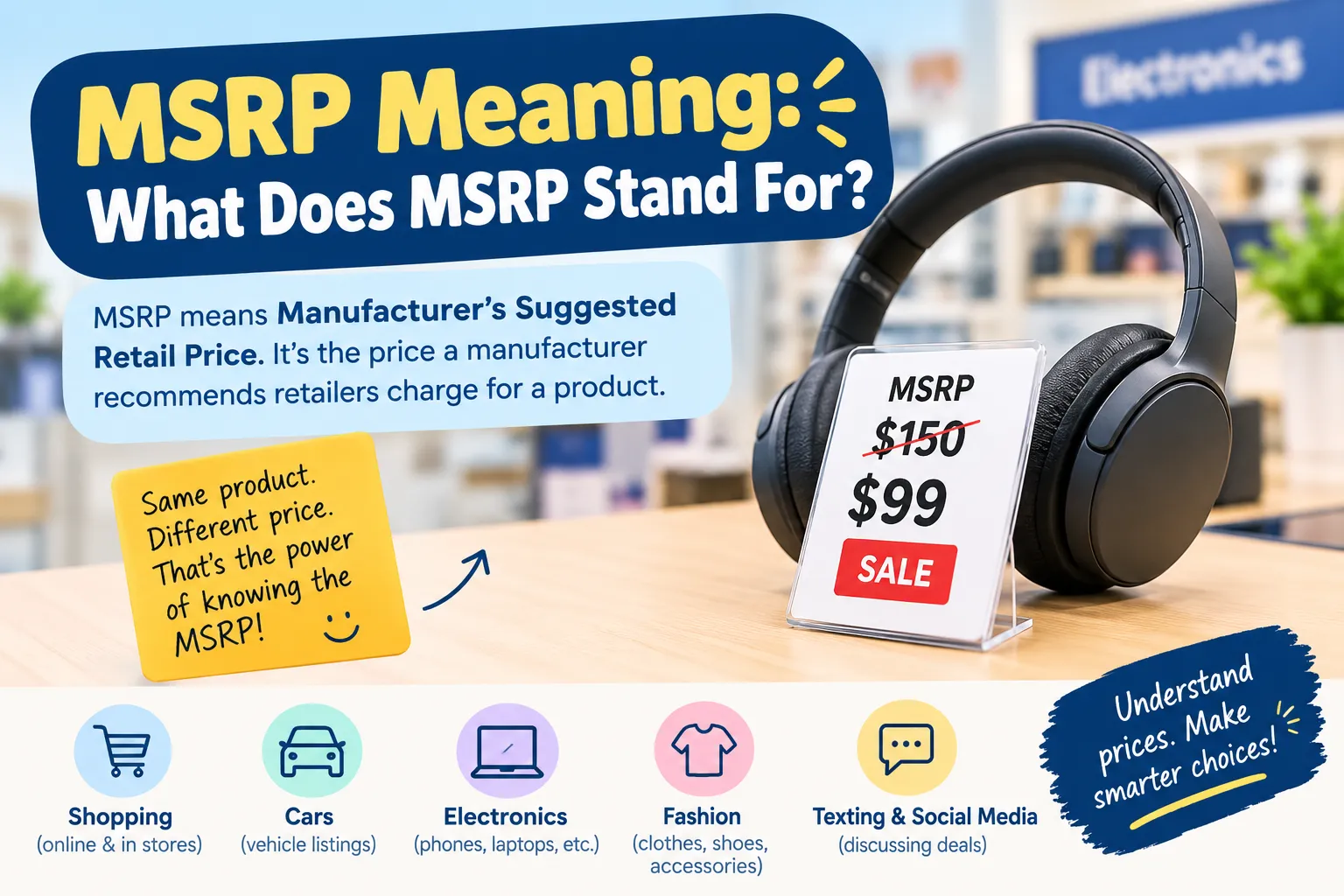
MSRP stands for Manufacturer’s Suggested Retail Price. It refers to the price a manufacturer recommends that retailers charge customers for a product.
For example, if a new pair of headphones has an MSRP of $150, a store might sell them for $130 during a promotion. Another retailer could potentially charge a different price.
You may see MSRP written in product descriptions, online stores, advertisements, car listings, and shopping conversations.
Example:
“I found these headphones for $99, but the MSRP is $149.”
In short: MSRP = Manufacturer’s Suggested Retail Price = the price a manufacturer recommends for selling a product.
📱 Where Is MSRP Commonly Used?
MSRP is not really texting slang. It is a common shopping, business, and pricing abbreviation that can also appear in casual online conversations.
You may see it on:
- 🛒 Online shopping: Product pages often display MSRP beside sale prices.
- 🚗 Car websites: Vehicle listings commonly mention MSRP.
- 📱 Electronics: Phones, laptops, headphones, and other devices may have an MSRP.
- 👟 Fashion: Shoes, clothing, and accessories can be advertised using MSRP.
- 💬 Texting: Someone might mention MSRP while discussing whether a deal is good.
- 📸 Social media: Product reviews and shopping posts may compare a sale price with MSRP.
- 🏷️ Retail advertisements: Stores sometimes show MSRP to highlight discounts.
Tone: MSRP is neutral, professional, and informational. It is not normally considered flirty, emotional, or casual slang.
💬 Examples of MSRP in Conversation
Here are some realistic examples of how people might use MSRP in chats:
A: how much was that laptop originally?
B: the msrp was $1,200, but i got it for $850 😎
A: is this actually a good deal?
B: yeah, the msrp is $500 and it’s on sale for $350.
A: what does msrp mean? 🤔
B: manufacturer’s suggested retail price.
A: the car dealer says the price is close to msrp.
B: that’s basically the manufacturer’s recommended price.
A: this jacket says $200 msrp but it’s only $80 today 👀
B: that sounds like a pretty big discount.
A: why is the msrp different from the price?
B: stores can sell products for prices that differ from the manufacturer’s suggestion.
A: i’m comparing these two phones right now.
B: check the msrp too, then compare the actual selling prices.
🕓 When to Use and When Not to Use MSRP
✅ When To Use
Use MSRP when:
- You are comparing product prices.
- You are discussing a discount.
- You are researching a new car.
- You are talking about a manufacturer’s recommended price.
- You are comparing different retailers.
- You are discussing whether a sale represents a good deal.
- You are writing about product pricing.
❌ When Not to Use
Avoid using MSRP when:
- You simply mean the price you personally paid.
- You are talking about an item’s current sale price only.
- The manufacturer does not provide an MSRP.
- You need to describe a final price that includes taxes, fees, or other charges.
- Your audience may not understand the abbreviation and there is no context.
| Context | Example Phrase | Why It Works |
|---|---|---|
| Friend Chat | “the msrp is $300 but i found it for $220 😄” | Casual and easy to understand |
| Work Chat | “The product has an MSRP of $300.” | Clear and professional |
| “The manufacturer’s suggested retail price is $300.” | Formal and precise | |
| Shopping | “Sale price: $220 vs. MSRP: $300” | Makes the discount easy to compare |
| Product Review | “Its MSRP is $300, but retailers often sell it for less.” | Provides useful pricing context |
🔄 Similar Pricing Terms or Alternatives
| Term | Meaning | When to Use |
|---|---|---|
| MSRP | Manufacturer’s Suggested Retail Price | Manufacturer-recommended pricing |
| Retail Price | Price at which a retailer sells a product | General shopping discussions |
| List Price | Published or listed price | Product listings and catalogs |
| Sale Price | Temporary discounted price | Promotions and deals |
| Wholesale Price | Price generally charged when products are sold to retailers in bulk | Business and supply discussions |
| MAP | Minimum Advertised Price | Discussions about advertised pricing policies |
MSRP vs. Sale Price
One of the easiest ways to understand MSRP is to compare it with a sale price.
Suppose a television has an MSRP of $800. A retailer might advertise it for $650 during a sale. The $800 figure is the manufacturer’s suggested price, while $650 is what the retailer is currently asking.
This means MSRP does not necessarily represent the amount you will actually pay.
MSRP vs. Actual Price
The actual selling price can be higher or lower than MSRP depending on the product, retailer, demand, promotions, location. And other factors.
This is particularly noticeable with products such as cars, where additional fees, options, taxes. And dealer pricing can affect the final amount.
You have probably seen the letters MSRP on a car window sticker, a product page. Or an advertisement, right next to a price that looks higher than the price you actually pay. Many shoppers wonder whether that number is the real price, a starting point for negotiation, or just a marketing trick. The short answer is that MSRP is a suggestion, not a final bill. And understanding it can save you real money.
MSRP shows up most often when you shop for cars, electronics, appliances, furniture, and toys. It gives you a reference point. When a store lists an MSRP of 500 dollars and a sale price of 399 dollars, the MSRP tells you what the manufacturer recommended, while the sale price tells you what the store is actually asking. Once you know how that gap works, you can compare offers, spot fake discounts, and negotiate with confidence.
In this guide, you will learn the full meaning of MSRP, what it includes, what it leaves out, how it differs from invoice price, sticker price. And sale price, and how to use it when you buy a car or any other product. You will also find practical negotiation tips, common mistakes to avoid. And clear answers to the questions shoppers ask most often.
MSRP Meaning in Simple Words
MSRP stands for Manufacturer’s Suggested Retail Price. It is the price that the maker of a product recommends that stores charge customers. The word manufacturer means the company that makes the product. The word suggested means the price is a recommendation, not a rule. The word retail means the price paid by the final customer. The word price is the amount of money involved.
Put together, the Manufacturer’s Suggested Retail Price is the price the manufacturer thinks a product should sell for in stores. Retailers are usually free to charge more or less than that number. That is why the same television, jacket. Or car can carry one MSRP and several different sale prices at different stores.
Think of MSRP as a starting line rather than a finish line. It anchors the conversation about price. A store can discount below it during a sale. And in times of high demand, a dealer can ask for more than it. In both cases, the MSRP remains the reference number that helps you judge whether the deal in front of you is fair.
What Does MSRP Include
What the MSRP covers depends on the product. But for most manufactured goods it reflects the basic cost of making the product, plus a margin that allows the manufacturer and the retailer to earn a profit. For cars, the MSRP is more detailed, because the window sticker breaks it into parts.
For a new car, the MSRP usually includes:
- Base price: the cost of the vehicle in its standard trim, with standard equipment, before you add options.
- Factory options and packages: the cost of added features that were installed at the factory, such as a sunroof, a premium sound system, or a tow package.
- Destination charge: the fee for shipping the vehicle from the factory to the dealership, which covers freight, handling, and delivery preparation.
For electronics, appliances, furniture. And other consumer goods, the MSRP usually reflects the standard version of the product as the manufacturer ships it. Extra accessories, extended warranties, installation services. And delivery upgrades are generally not part of the MSRP unless the manufacturer states that they are included.
What MSRP Does Not Include
The MSRP is not the total amount you pay at checkout. Several common charges sit outside the MSRP. And they can add a large amount to your final bill if you do not watch for them.
- Sales tax: tax is calculated on the sale price where you buy the product, and it is never part of the MSRP.
- Title and registration fees: for vehicles, the cost of registering the car in your name is separate from the MSRP.
- Dealer add-ons: extras a dealer installs or sells, such as paint protection, fabric treatment, nitrogen-filled tires, or VIN etching, are not part of the MSRP.
- Documentation fees: the fee a dealer charges for processing paperwork is separate from the MSRP and varies widely by dealer.
- Extended warranties and service plans: these optional protections are sold separately and are not included in the MSRP.
- Aftermarket accessories: anything added after the product leaves the factory is not part of the MSRP.
That is why smart shoppers always ask for the out-the-door price. The out-the-door price includes the sale price plus every fee, tax, and add-on. Comparing out-the-door prices across dealers is far more honest than comparing MSRP figures alone.
MSRP vs Invoice Price vs Sticker Price vs Sale Price
Car shopping uses several price terms that sound similar but mean different things. Mixing them up can cost you money, so here is a clear comparison.
MSRP
MSRP is the manufacturer’s suggested retail price. It is the public reference price shown on the window sticker and in brochures. It is the highest number most buyers see first. And it is the number dealers often try to anchor negotiations to.
Invoice Price
Invoice price is the amount the dealer supposedly paid the manufacturer for the vehicle. It is lower than the MSRP because it leaves room for the dealer to make a profit. Keep in mind that invoice price is not the dealer’s true cost, because manufacturers often pay dealers holdbacks, bonuses. And incentives that do not appear on the invoice.
Sticker Price
Sticker price is a casual term for the total MSRP shown on the window sticker of a new car, including base price, options. And destination charge. For most cars, sticker price and total MSRP mean the same thing.
Sale Price
Sale price is the amount the dealer or store is actually asking for the product right now. It can be below MSRP during a promotion or above MSRP when demand is high and supply is low. The sale price is the number that matters most, because it is the starting point for your final negotiation.
A simple way to remember the difference is this: MSRP is what the manufacturer suggests, invoice price is what the dealer claims to have paid, sticker price is the total shown on the label. And sale price is what you are actually being asked to pay.
MSRP on Cars and the Window Sticker
Every new car sold in the United States must carry a window sticker, known as the Monroney sticker, named after the senator who sponsored the law that requires it. The sticker shows the MSRP, the base price, the cost of each factory option, the destination charge. And the fuel economy ratings. Only the buyer is supposed to remove that sticker.
The window sticker exists to protect you. Before this law, dealers could describe a car however they liked. And buyers had no reliable way to know what equipment was included or what the manufacturer recommended as a price. The sticker gives you a standard, printed record that you can compare across dealers and models.
When you look at a window sticker, read it in three parts. First, check the base MSRP for the trim level. Second, read the list of factory options and their prices, and make sure the car actually has the equipment listed. Third, note the destination charge and the total MSRP at the bottom. Anything a dealer adds on a separate sheet, often called an addendum sticker, is a dealer markup or add-on, not part of the factory MSRP.
MSRP on Electronics, Appliances, and Everyday Products
MSRP is not only a car term. You will see it on headphones, laptops, phones, refrigerators, washing machines, furniture, clothing, shoes, toys, and sporting goods. In these categories, the MSRP works the same way: it is the manufacturer’s recommended shelf price. And stores may sell above or below it.
Retailers often show the MSRP next to the sale price to highlight a discount. For example, a jacket with an MSRP of 120 dollars and a sale price of 84 dollars looks like a 30 percent saving. That saving is real only if the MSRP reflects a price the product actually sold for at some point. Some sellers inflate the MSRP to make a normal price look like a deep discount. So always compare the sale price with other stores before you assume you found a bargain.
Another related term is MAP, which stands for Minimum Advertised Price. Some manufacturers set a minimum price below which retailers may not advertise a product. A store can still sell the product for less in private, but it cannot advertise a lower price. MAP policies help protect brand image and keep small retailers competitive. But they can also make it harder to spot the lowest price online.
How to Use MSRP When You Shop
Follow these steps to turn MSRP into a useful shopping tool instead of a confusing number.
Step 1: Start With the MSRP, Not the Monthly Payment
For cars, always negotiate the sale price of the vehicle first, before you discuss monthly payments, trade-in value, or financing. Dealers can hide a high price behind a low monthly payment by stretching the loan term. When the sale price is settled, the rest of the numbers become much easier to check.
Step 2: Compare the Same Product Across Sellers
Search the exact model name and trim, then compare sale prices from at least three sellers. The MSRP should be the same everywhere, because it comes from the manufacturer. If one seller shows a different MSRP for the same product, read the listing carefully, because the model, size. Or included accessories may differ.
Step 3: Ask for the Out-the-Door Price
Ask every dealer or store for the total price including all fees, taxes, and add-ons. Get that number in writing before you agree to buy. If a dealer will not give you an out-the-door price, treat that as a warning sign and shop elsewhere.
Step 4: Check Incentives and Rebates
Before you negotiate, check the manufacturer’s website for rebates, cash-back offers, loyalty bonuses, and special financing. Many of these incentives apply on top of any discount the dealer offers. So a car advertised at MSRP may still carry a large effective discount once incentives are applied.
Common MSRP Mistakes to Avoid
- Treating MSRP as the final price: the MSRP is a suggestion, so always ask what the actual sale price is.
- Ignoring fees: a low sale price can hide high documentation fees, add-ons, and delivery charges, so always compare out-the-door prices.
- Trusting a fake discount: an inflated MSRP can make a normal price look like a bargain, so compare sale prices across sellers.
- Negotiating the monthly payment instead of the price: a small monthly payment over a long loan can cost far more in total interest.
- Paying for add-ons you did not ask for: decline paint protection, fabric treatment, and other extras unless you genuinely want them.
- Skipping the window sticker: on a new car, always read the factory sticker and match it against the vehicle you are buying.
What does MSRP stand for?
MSRP stands for Manufacturer’s Suggested Retail Price. It is the price the manufacturer recommends that retailers charge customers for a product.
Is MSRP the same as the sale price?
No. The MSRP is a recommendation from the manufacturer, while the sale price is what the store is actually asking. The sale price can be lower than MSRP during a promotion or higher than MSRP when demand is strong.
Can you negotiate below MSRP?
Yes, in most cases you can negotiate below MSRP, especially for cars. Dealers often expect negotiation, and manufacturer rebates and incentives can push the final price well below MSRP. The best approach is to research sale prices at several dealers and negotiate the sale price, not the monthly payment.
Does MSRP include tax and fees?
No. MSRP does not include sales tax, title and registration fees, documentation fees, dealer add-ons, or extended warranties. Always ask for the out-the-door price to see the full cost.
Why do some dealers charge more than MSRP?
Dealers may charge more than MSRP when a vehicle is in high demand and supply is limited. This extra amount is often called a market adjustment. You are not required to pay it. And you can shop at another dealer, wait for supply to improve, or negotiate the markup down.
❓ FAQs:
1. What does MSRP stand for?
MSRP stands for Manufacturer’s Suggested Retail Price.
2. What does MSRP mean?
It is the price a manufacturer recommends retailers use when selling a product.
3. Is MSRP the actual price?
Not necessarily. A retailer may sell an item for more or less than the MSRP.
4. Is MSRP the same as retail price?
Not always. MSRP is a manufacturer’s recommendation, while the retail price is the amount a retailer actually charges.
5. Why do stores show MSRP?
Stores may show MSRP to give shoppers a reference point for the product’s pricing or discount.
6. Is MSRP used for cars?
Yes. MSRP is commonly used when discussing vehicle pricing.
7. Is MSRP used for electronics?
Yes. Phones, laptops, televisions, headphones, cameras, and other electronics can have an MSRP.
8. Is MSRP a discount?
No. MSRP is a recommended price. A discount occurs when an item is offered below a reference or regular price.
9. Can a store charge less than MSRP?
Yes. Retailers can offer products at lower prices, depending on applicable pricing rules and circumstances.
10. Can a product sell above MSRP?
In some markets and situations, yes. Actual pricing can vary because of demand, availability, retailer policies, and other factors.
11. Is MSRP a slang word?
No. MSRP is a pricing abbreviation rather than traditional internet slang.
12. What is the difference between MSRP and sale price?
MSRP is the manufacturer’s suggested price, while the sale price is the amount a retailer is currently charging after a promotion or discount.
13. What does MSRP mean on Amazon?
It generally refers to the manufacturer’s suggested retail price used as a reference for the product’s pricing.
14. What does MSRP mean on a car?
For a vehicle, MSRP generally refers to the manufacturer’s suggested price for the vehicle before considering certain additional costs and adjustments.
15. Is MSRP negotiable?
MSRP itself is a suggested price, while the actual selling price may sometimes be negotiable depending on the product and seller.
16. Why is MSRP higher than the current price?
A retailer may be offering a promotion, clearance discount, or other reduced price.
17. Is MSRP the same as list price?
The terms can sometimes be used similarly, but their exact meaning can depend on the industry and context.
18. What does MSRP mean in texting?
In texting, MSRP still means Manufacturer’s Suggested Retail Price. It is usually used while discussing products or prices.
19. Should I compare MSRP when shopping?
Yes. Comparing MSRP with the actual selling price can help you understand the advertised discount, although MSRP should not be the only factor you consider.
20. What is the simplest meaning of MSRP?
The simplest meaning is the price a manufacturer recommends a retailer charge for a product.
MSRP and Trade In Value
Trade in value is a separate number from MSRP, and mixing the two up can make a deal look better than it really is. MSRP describes what the manufacturer suggested for a new product, while trade in value describes what a dealer offers for your used item. When you trade in a car, the dealer will quote a trade in figure, a sale price for the new car, and a difference to pay. Always judge each number on its own, because a generous trade in offer can hide a weak discount on the new car, and a big discount can hide a low trade in offer.
Before you visit a dealer, check the rough value of your current car from at least two independent sources, and write down the MSRP and the sale price of the car you want. Then ask the dealer to show the trade in value, the sale price, and every fee as separate lines. If the dealer only talks about the monthly payment or the difference to pay, ask for the full breakdown in writing. A clear breakdown protects you, because it lets you compare the same numbers across dealers instead of comparing vague promises.
MSRP Questions to Ask Before You Sign
A few calm questions can save you real money, and they also show the seller that you understand the numbers. Ask these before you agree to anything, and take notes on the answers so you can compare dealers later.
- Is this the total MSRP including the destination charge? – The answer tells you whether the quoted figure is complete or missing a standard charge.
- What is the sale price before any rebates? – This separates the dealer discount from manufacturer incentives that may change later.
- Which fees sit outside the sale price? – Documentation fees, registration costs, and add-ons should be named clearly, not discovered at signing.
- Can I see the out-the-door price in writing? – A written total removes surprises and gives you a fair basis for comparison.
- Are any add-ons already fitted to this item? – Extras fitted by the dealer are not part of factory MSRP, so ask whether they can be removed.
- How long is this price valid? – A time limit is normal, but you should know it before you leave to think things over.
If a seller cannot answer these questions plainly, treat that as useful information in itself. A confident seller welcomes clear questions, while an evasive one is telling you to shop elsewhere.
Does a high trade in offer mean I got a good deal?
Not on its own, because the dealer may have raised the sale price to cover the generous trade in figure. Judge the trade in value and the sale price separately, then look at the total difference to pay.
Should I negotiate the trade in value first?
It is usually wiser to settle the sale price of the new item first, then discuss the trade in value. Keeping the two talks separate stops one number from quietly covering weakness in the other.
Can MSRP change after a model year ends?
Yes, manufacturers set a new MSRP for each model year, and remaining stock from an older year may carry different incentives. Always check which model year the MSRP belongs to before comparing prices.
Is it rude to ask for every fee in writing?
No, it is normal and sensible. A written out-the-door price protects both sides, because it leaves no room for misunderstanding about what was agreed.
🎯 Conclusion:
MSRP means “Manufacturer’s Suggested Retail Price.” It is mainly used in shopping, retail, automotive, and product discussions rather than as casual slang.
When you see MSRP next to a lower price, it usually gives you a reference for comparing the current offer. Just remember that MSRP is a suggested price, not necessarily the final amount you will pay.

I am writing about Rick Riordan, a famous American author best known for creating the popular Percy Jackson & the Olympians series. I am highlighting his talent for combining mythology with modern storytelling, which has made his books loved by millions of readers around the world. On namezvibez.com, I am exploring his creative writing style, bestselling novels, and the impact he has had on young readers and fantasy literature.