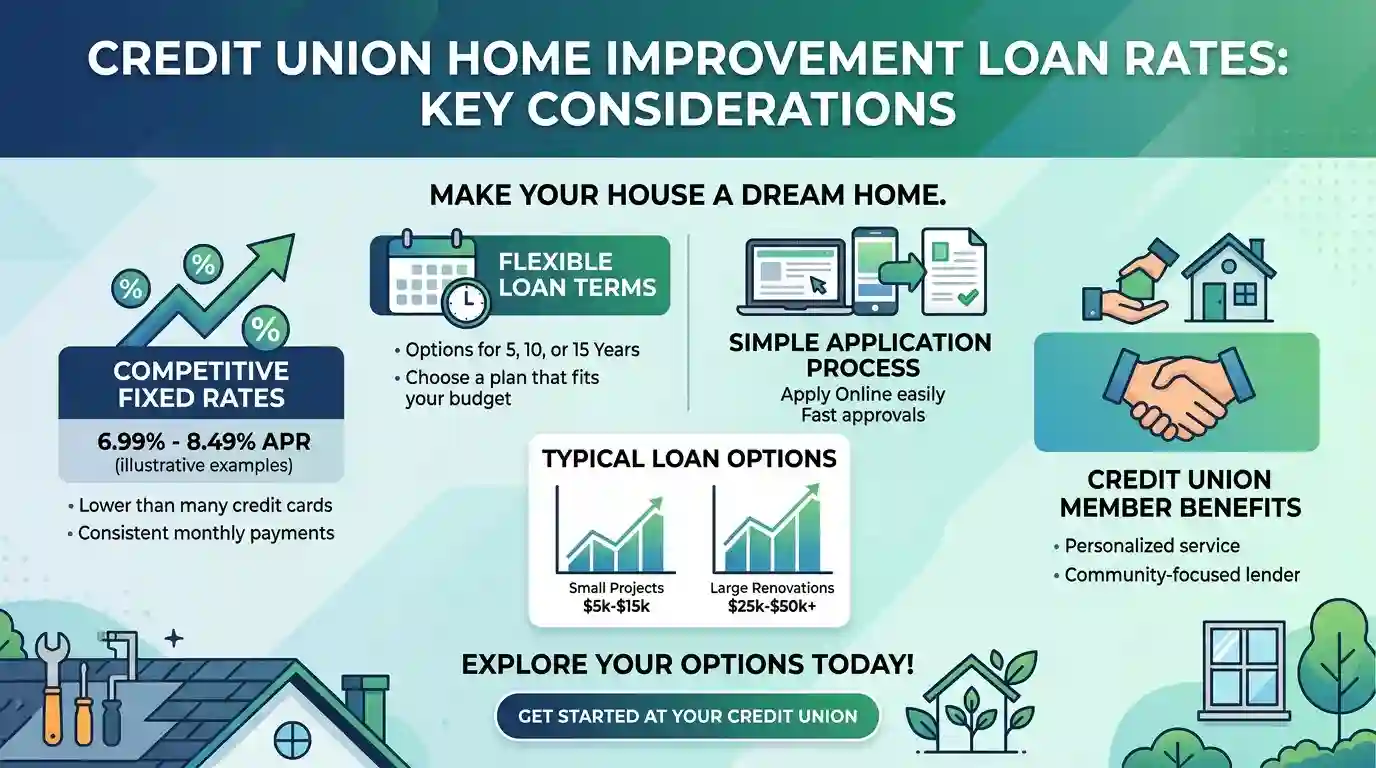
Credit union home improvement loan rates vary by lender, credit score, loan amount, repayment term, and whether the loan is secured. Credit unions may offer competitive rates on personal loans and home renovation financing, but the best option depends on your credit profile, fees, and monthly budget. Compare APRs and total borrowing costs before applying.
Key Takeaways
- Credit union home improvement loan rates depend on your credit history, income, loan term, and loan type.
- Credit unions may offer competitive financing, but rates and eligibility requirements vary by institution.
- Compare APRs, fees, repayment periods, and total interest instead of looking at interest rates alone.
- Personal loans, home equity loans, and HELOCs each have different costs and risks.
- Getting quotes from several credit unions can help you find affordable financing for your project.
credit union home improvement loan rates
Introduction
Credit union home improvement loan rates can make a real difference in how much you pay to repair, upgrade, or renovate your home. Whether you want to replace an aging roof, remodel a kitchen, install energy-efficient windows, or update a bathroom, the right loan can help you manage the cost without draining your savings.
Credit unions often provide specialized home improvement loans, unsecured personal loans, and home equity financing. However, interest rates, loan limits, membership rules, and repayment terms vary from one institution to another.
The advertised rate is only a starting point. Your credit score, income, existing debts, loan amount, and repayment period can affect the offer you receive. Some lenders also offer discounts for automatic payments or specific energy-saving projects.
This guide explains how credit union home improvement loan rates work, compares published rates from selected U.S. credit unions, and shows you how to evaluate loan costs before applying. Rates are examples published in October 2026 and may change.
What Do Credit Union Home Improvement Loan Rates Mean?
Credit union home improvement loan rates are the borrowing costs charged by credit unions for financing eligible home repairs, renovations, and upgrades. Lenders usually express these costs as an annual percentage rate (APR), which helps borrowers compare financing offers.
A lower APR generally means lower borrowing costs when you compare loans with the same amount and repayment term. However, you should also check fees, payment schedules, and whether the rate is fixed or variable.
Credit unions are member-owned financial institutions. Many require you to meet membership eligibility rules before you can apply, although some allow you to join through a small deposit or an eligible community or organizational connection.
Home improvement financing can cover projects such as:
- Kitchen and bathroom remodeling
- Roof replacement and structural repairs
- New windows, doors, and insulation
- Heating and cooling system upgrades
- Flooring, painting, and accessibility improvements
- Eligible solar or energy-efficiency projects
Each lender sets its own rules about eligible projects, required documents, and whether you must own and occupy the property.
Why Compare Credit Union Home Improvement Loan Rates?
Comparing several lenders helps you avoid choosing a loan based only on an attractive advertised rate. Two offers with similar APRs can have different fees, borrowing limits, and repayment periods.
Compare offers to:
- Reduce interest costs: A lower APR can save money over the life of the loan.
- Find suitable repayment terms: A shorter term may reduce total interest, while a longer term can lower monthly payments.
- Identify hidden costs: Origination fees and closing costs can increase the overall expense.
- Choose the right loan type: Unsecured loans do not put your home up as collateral, while home equity financing does.
- Check eligibility: Membership, credit, income, and property requirements can vary.
The goal is to find financing that fits your budget, not simply the loan with the lowest advertised rate.
Current Credit Union Home Improvement Loan Rates
The following examples come from published lender rate pages available in October 2026. They illustrate how much rates and terms can vary. They are not a nationwide average or a guarantee of approval.
| Credit union | Advertised rate | Example terms |
|---|---|---|
| Waypoint Credit Union | 7.99% APR | Up to 60 months; maximum $50,000 |
| Tower Federal Credit Union | 7.49% APR | Advertised starting rate; terms depend on qualification |
| Navy Federal Credit Union | 8.74% APR | Home improvement loan up to 180 months |
| Visions Federal Credit Union | 9.49% APR | 120 months; automatic-payment conditions apply |
| MSU Federal Credit Union | 9.99% APR | Starting rate for terms up to 36 months |
Sources: Waypoint Waypoint Credit Union, Tower Federal Tower, Navy Federal Navy Federal Credit Union, Visions Visions Federal Credit Union, and MSU Federal MSU Federal Credit Union. Rates and terms are subject to change.
These examples show why you should compare offers carefully. Waypoint advertises different rates for longer repayment periods, while Navy Federal lists a home improvement loan separately from its home equity products. MSU Federal’s starting rate increases for longer terms. The products are not identical, so the lowest number alone does not establish the best deal.
Before applying, visit the lender’s official rate page and confirm its current APR, fees, maximum loan amount, repayment term, and membership requirements.
What Affects Your Home Improvement Loan Rate?
Credit unions review several factors before deciding which rate to offer you. Understanding these factors can help you prepare a stronger application.
1. Credit Score and Credit History
Your credit score helps lenders assess how reliably you have managed debt. Applicants with stronger credit histories may qualify for lower APRs, while applicants with missed payments, high balances, or limited credit histories may receive higher rates or face stricter approval requirements.
Check your credit reports before applying. Correct any inaccurate information and avoid taking on unnecessary debt while you shop for financing.
2. Income and Debt-to-Income Ratio
Lenders consider your income and existing monthly debt payments to determine whether you can afford another loan. A lower debt-to-income ratio may strengthen your application, although each credit union uses its own underwriting standards.
Prepare recent pay stubs, tax documents, or other acceptable proof of income. Self-employed borrowers may need additional records.
3. Loan Amount and Repayment Term
The amount you borrow and the time you take to repay it can affect your APR. Some credit unions offer different rates for 36-, 60-, 120-, or 180-month terms.
Longer repayment periods generally reduce monthly payments but can increase the total interest you pay. Compare the monthly payment and total borrowing cost together.
4. Collateral and Loan Type
Some home improvement loans are unsecured, meaning you do not pledge your home as collateral. Others use home equity or another asset to secure the debt.
Secured financing may offer a lower rate in some cases, but it puts the pledged asset at risk if you fail to repay. Compare both options before deciding.
5. Automatic Payments and Member Discounts
Certain credit unions offer lower rates when you enroll in automatic payments or maintain a qualifying account relationship. For example, Visions Federal Credit Union lists a relationship-based rate that requires automatic payments, with a rate adjustment if you do not enroll. Visions Federal Credit Union
Ask whether the advertised rate includes a discount and what happens if you stop meeting the conditions.
Credit Union Home Improvement Loans vs. Other Financing Options
The best loan depends on your project’s cost, your available home equity, and how much repayment flexibility you need.
| Financing option | Main benefit | Main drawback |
|---|---|---|
| Credit union home improvement loan | May offer fixed payments and project-specific terms | Eligibility and rates vary |
| Unsecured personal loan | No home collateral required | Rates may be higher than secured financing |
| Home equity loan | Often offers fixed payments and a set repayment schedule | Your home secures the debt |
| Home equity line of credit (HELOC) | Flexible access to funds as needed | Often has a variable rate and uses your home as collateral |
| Credit card | Convenient for smaller purchases | Interest can be expensive if you carry a balance |
| Contractor financing | May offer promotional terms for eligible projects | Promotional periods and deferred-interest terms require careful review |
A dedicated credit union home improvement loan may suit a project with a clear budget and a single upfront cost. A HELOC may be more practical when you expect several expenses over time, but variable rates can make future payments less predictable.
For energy upgrades, check whether your state, utility company, or local credit union offers a special financing program. Some programs provide lower rates for eligible improvements such as insulation, efficient heating systems, or solar installations.
How Much Will a Credit Union Home Improvement Loan Cost?
Your monthly payment depends on the amount borrowed, APR, and repayment period. The following examples use a fixed-rate loan with monthly payments and assume no additional fees.
Example: Borrowing $20,000
Illustrative payments at a 9% fixed APR
3-year term
$636/mo
About $2,900 total interest
5-year term
$415/mo
About $4,900 total interest
These are rounded estimates, not lender quotes. Actual payments depend on your approved APR, loan structure, and fees.
The five-year term lowers the monthly payment by about $221, but it costs roughly $2,000 more in interest over the full repayment period. This is why the smallest monthly payment is not always the most affordable option overall.
When reviewing an offer, ask for a written payment schedule showing the APR, monthly payment, total interest, and any fees.
How to Find the Best Credit Union Home Improvement Loan Rates
Follow these steps to compare offers efficiently.
- Set your project budget. Get contractor estimates and include a reasonable allowance for unexpected costs.
- Check your credit. Review your credit reports and estimate what monthly payment you can comfortably afford.
- Research eligible credit unions. Look at local institutions, employer-affiliated credit unions, and national options for which you qualify.
- Compare APRs and fees. Ask for the full APR, origination charges, closing costs, and any required account fees.
- Compare equal terms. Review offers for the same loan amount and repayment period to make the comparison fair.
- Ask about prequalification. When available, prequalification can help you estimate your rate before submitting a full application. Confirm whether it involves a soft or hard credit inquiry.
- Read the final agreement. Verify the approved rate, repayment schedule, late-payment fees, and early-payment rules before signing.
Do not submit multiple full applications without checking how each lender handles credit inquiries. When possible, collect preliminary quotes first and submit formal applications within a short shopping period.
Common Mistakes to Avoid
- Choosing a loan based only on its advertised starting APR. The lowest rate may be reserved for highly qualified borrowers.
- Ignoring fees. An origination fee or closing cost can make an otherwise attractive offer more expensive.
- Focusing only on monthly payments. Longer terms can increase total interest, even when payments seem manageable.
- Confusing unsecured loans with home equity loans. The collateral requirements and risks are different.
- Assuming every credit union accepts every applicant. Membership eligibility, location, and property requirements may limit your options.
A careful comparison helps you avoid surprises and choose financing that fits your financial situation.
Frequently Asked Questions
1. What are the current credit union home improvement loan rates?
Rates vary by credit union, credit profile, loan amount, and repayment term. Published examples in October 2026 include starting APRs from 7.49% at Tower Federal Credit Union and 7.99% at Waypoint Credit Union. These are lender-specific offers, not guaranteed rates or a national average. Tower+1
2. Are credit unions cheaper than banks for home improvement loans?
Credit unions can offer competitive rates, but they are not always cheaper than banks. Your approved APR, fees, repayment period, and eligibility determine the actual cost. Compare written offers from both types of lenders using the same loan amount and term before making a decision.
3. What credit score do I need for a credit union home improvement loan?
There is no single credit score requirement for every credit union. Each lender sets its own approval standards and may consider income, existing debts, payment history, and collateral alongside your score. Ask about minimum requirements and prequalification options before submitting a full application.
4. Can I get a home improvement loan without home equity?
Yes. Some credit unions offer unsecured home improvement loans that do not require you to borrow against your home’s equity. These loans can be useful if you have limited equity or prefer not to pledge your property. Approval, interest rates, and maximum loan amounts still depend on the lender’s requirements.
5. Are credit union home improvement loans fixed-rate or variable-rate?
Many dedicated home improvement installment loans offer fixed rates, giving borrowers predictable monthly payments. Some credit unions also provide variable-rate lines of credit. Check the loan agreement carefully because a variable rate can increase, raising your borrowing costs and potentially changing your required payments.
6. How much can I borrow from a credit union for home improvements?
Loan limits depend on the lender, your creditworthiness, income, and the type of financing. For example, Waypoint Credit Union advertises home improvement loans up to $50,000, while Navy Federal lists amounts from $250 to $150,000 for its home improvement loan. Actual approval limits may be lower. Waypoint Credit Union+1
7. Can I pay off a credit union home improvement loan early?
Some credit unions allow early repayment without a penalty, but you should confirm this before signing. Check whether the contract includes a prepayment fee and whether extra payments reduce the principal. Paying down principal sooner can reduce future interest when the loan terms allow it.
8. How do I get the lowest credit union home improvement loan rate?
Start by comparing several credit unions, checking your credit reports, and choosing a repayment term that fits your budget. Ask about automatic-payment discounts, origination fees, and special energy-efficiency programs. Compare the final APR and total repayment cost rather than relying on advertised starting rates alone.
Conclusion
Credit union home improvement loan rates can vary widely, so comparing lenders is an important step before starting a renovation. A competitive offer should combine an affordable APR, manageable monthly payments, reasonable fees, and repayment terms that suit your budget.
Start by checking dedicated home improvement loans at credit unions where you qualify for membership. Then compare unsecured personal loans with home equity loans or HELOCs if you have sufficient equity and are comfortable using your property as collateral. Consider both monthly payments and total interest before choosing a term.
Remember that an advertised starting rate is not necessarily the rate you will receive. Ask for a written quote, confirm all fees, and review the repayment agreement carefully.

I am writing about Rick Riordan, a famous American author best known for creating the popular Percy Jackson & the Olympians series. I am highlighting his talent for combining mythology with modern storytelling, which has made his books loved by millions of readers around the world. On namezvibez.com, I am exploring his creative writing style, bestselling novels, and the impact he has had on young readers and fantasy literature.