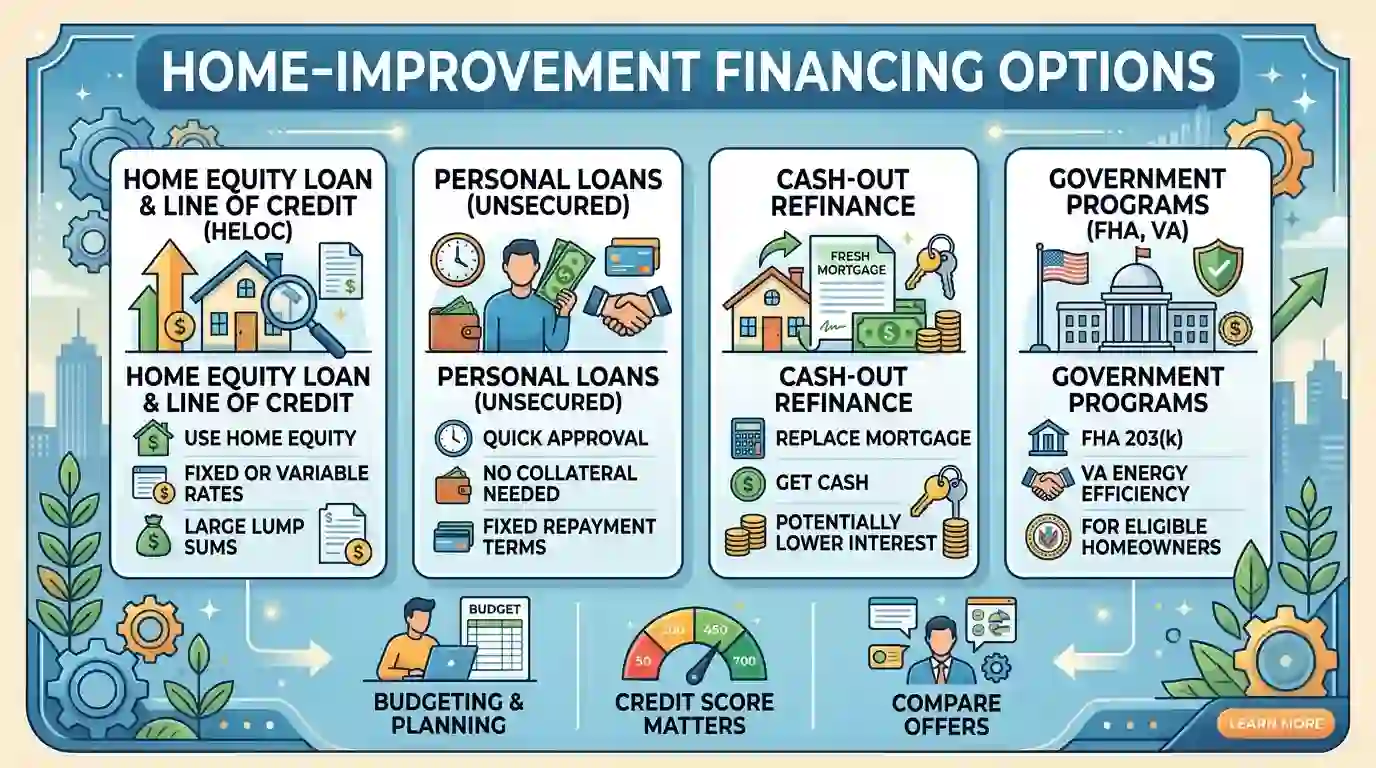
Home improvement financing options help homeowners pay for repairs, renovations, and upgrades without covering the full cost upfront. Common choices include personal loans, home equity loans, HELOCs, cash-out refinancing, credit cards, and government-backed programs. The right option depends on your budget, credit score, available home equity, project size, and repayment ability.
Key Takeaways
- Personal loans provide funding without using your home as collateral.
- Home equity loans offer fixed payments and may work well for larger projects.
- HELOCs provide flexible access to money as renovation costs arise.
- Credit cards can cover smaller projects, but high interest rates can make borrowing expensive.
- Government-backed programs may help eligible homeowners finance necessary repairs and energy improvements.
Home improvement financing options: A Complete Guide for Homeowners
Homeowners often need money for projects that make their properties safer, more comfortable, or more valuable. These projects can include replacing an old roof, remodeling a kitchen, upgrading a bathroom, installing new windows, or repairing damaged plumbing.
However, paying for a major renovation with savings is not always possible. That’s why many homeowners explore different home improvement financing options before hiring a contractor or purchasing materials.
The good news is that you don’t have to rely on one type of financing. You can choose from personal loans, home equity products, credit cards, government-backed programs, and contractor payment plans. Each option has different costs, approval requirements, and repayment rules.
In this guide, you’ll learn how these financing methods work, where each one makes sense, what mistakes to avoid, and how to choose an affordable solution for your next project.
What Does Home Improvement Financing Options Mean?
Home improvement financing options are the different ways homeowners can borrow or access money to pay for repairs, renovations, and property upgrades.
These options may include unsecured personal loans, secured home equity loans, lines of credit, credit cards, and government-supported repair programs.
People commonly use this financing for projects such as:
- Roof replacement and structural repairs.
- Kitchen and bathroom remodeling.
- Heating and air conditioning upgrades.
- Flooring, painting, and window replacement.
- Plumbing and electrical improvements.
- Energy-efficient home upgrades.
The main purpose is to spread renovation costs over time instead of paying the entire amount upfront.
Why Consider Different Home Improvement Financing Options?
Comparing financing methods can help you find a loan that matches your project and financial situation.
Here are some important benefits:
- Avoid unnecessary debt: Choose an amount that matches your actual renovation budget.
- Manage monthly expenses: Spread large project costs across scheduled payments.
- Protect emergency savings: Keep some cash available for unexpected expenses.
- Compare interest rates: Find competitive terms before accepting an offer.
- Choose suitable repayment terms: Match the repayment period to your financial capacity.
- Complete essential repairs: Address problems before they become more expensive.
Remember that borrowing is not automatically cheaper than paying cash. Interest, fees, and repayment periods can increase the total project cost.
10 Best Home Improvement Financing Options
The following ten methods cover common ways American homeowners can pay for renovation projects. Their suitability depends on the amount needed, credit history, available equity, and ability to repay.
1. Personal Loans
A personal loan is an unsecured loan that provides a lump sum you can use for eligible home improvement expenses. You repay the borrowed amount through scheduled monthly payments, usually with a fixed interest rate.
Because the loan doesn’t normally require your home as collateral, it may suit homeowners who have limited equity or don’t want to secure renovation debt against their property.
Best For: Smaller and medium-sized projects, including bathroom upgrades, flooring, and essential repairs.
Example 1: A homeowner takes out a personal loan to replace damaged flooring throughout the house.
Example 2: A family uses a fixed-rate loan to renovate an outdated bathroom and pays it back over several years.
Quick Tip: Compare the annual percentage rate (APR), origination fees, and total repayment amount rather than choosing a lender based only on the monthly payment.
2. Home Equity Loans
A home equity loan allows you to borrow against the equity you’ve built in your property. The lender provides a lump sum, and you generally repay it through fixed monthly payments.
This option can work well when you have substantial equity and know the renovation budget in advance. However, your home serves as collateral, so missed payments can put your property at risk.
Best For: Major renovations, roof replacements, and large remodeling projects.
Example 1: A homeowner borrows against existing equity to complete a full kitchen renovation.
Example 2: A family uses a home equity loan to repair structural damage and replace an aging roof.
Quick Tip: Check closing costs, appraisal fees, interest rates, and the effect of adding another monthly debt payment.
3. Home Equity Line of Credit (HELOC)
A HELOC is a revolving credit line that lets you borrow money against your home’s equity up to an approved limit. Unlike a traditional home equity loan, you can withdraw funds as needed during the draw period.
This flexibility makes it useful for projects with changing costs or several stages. Many HELOCs have variable interest rates, meaning payments can increase when rates rise.
Best For: Multi-stage renovations, ongoing repairs, and projects with uncertain final costs.
Example 1: A homeowner uses a HELOC to pay for kitchen cabinets first and countertops later.
Example 2: Someone renovating an older property withdraws money as different repair bills arrive.
Quick Tip: Understand the draw period, repayment period, variable rate, and possible balloon payment before signing. Your home is collateral.
4. Cash Out Refinancing
Cash-out refinancing replaces your existing mortgage with a new, larger mortgage. You receive the difference between the new loan balance and the old mortgage payoff, after applicable costs.
Homeowners sometimes use this money for major improvements. However, refinancing may increase your interest costs or replace an existing low mortgage rate with a higher one.
Best For: Homeowners who can secure favorable refinancing terms and need a substantial amount for renovations.
Example 1: A homeowner refinances a mortgage and uses part of the available cash to build an additional room.
Example 2: A family replaces its existing mortgage with a larger loan to fund several major property upgrades.
Quick Tip: Compare the new APR, closing costs, loan term, and total interest against keeping your current mortgage and choosing another financing method.
5. Credit Cards
Credit cards provide a convenient way to pay for smaller home improvement expenses. Some cards offer introductory promotional APR periods, which may help when you can repay the balance before the promotion ends.
However, regular credit card interest rates can be high. Carrying a large balance for several months can make an inexpensive project much more costly.
Best For: Small repairs, tools, paint, fixtures, and materials that you can repay quickly.
Example 1: A homeowner uses a credit card to purchase paint and lighting fixtures for a bedroom update.
Example 2: Someone pays for replacement plumbing fixtures with a card and clears the balance within the promotional period.
Quick Tip: Check when promotional rates expire and what APR applies afterward. Avoid financing a large renovation with a card you cannot repay promptly.
6. Contractor Financing
Some home improvement contractors work with lenders to offer financing plans to customers. These arrangements may include fixed monthly payments, promotional interest rates, or deferred payment offers.
They can make projects easier to arrange, but the financing terms may differ from those available through banks and credit unions.
Best For: Roofing, window installation, HVAC replacement, and other contractor-managed projects.
Example 1: A homeowner chooses a contractor’s financing plan to replace an outdated heating system.
Example 2: A family arranges monthly payments through a participating lender for a window replacement project.
Quick Tip: Compare the contractor’s financing offer with independent loan offers. Check promotional deadlines, deferred interest conditions, and contractor credentials.
7. FHA 203(k) Rehabilitation Loan
The FHA 203(k) program combines eligible home purchase or refinancing costs with funds for qualifying repairs and improvements in one mortgage.
It is particularly useful for buyers purchasing a property that needs renovation. Existing homeowners may also qualify through the appropriate refinancing route, subject to program rules.
Best For: Eligible homebuyers and homeowners planning substantial rehabilitation work.
Example 1: A buyer purchases an older house and includes approved renovation costs in an FHA 203(k) mortgage.
Example 2: An eligible homeowner refinances a property and finances qualifying improvements through the program.
Quick Tip: Work with an FHA-approved lender and confirm which repairs, contractors, documentation, and project costs meet current program requirements.
8. HUD Title I Property Improvement Loan
The HUD Title I Property Improvement Loan Program helps eligible homeowners finance certain repairs and improvements through approved private lenders. HUD insures participating lenders against losses rather than directly lending money to homeowners.
The program can support improvements that protect or improve a property’s basic livability or usefulness. Specific eligibility requirements and loan limits apply.
Best For: Homeowners who need eligible repairs or improvements and want to explore a HUD-insured loan.
Example 1: A homeowner applies through an approved lender to finance essential property repairs.
Example 2: A property owner explores Title I financing to improve the home’s basic living conditions.
Quick Tip: Use HUD’s official resources to find approved lenders and verify current loan limits before applying.
9. Government and Local Home Repair Assistance
Federal, state, county, and local programs may provide eligible homeowners with grants, loans, or other assistance for specific home repairs.
Some programs focus on low-income households, rural residents, veterans, older adults, or people living in properties that need safety improvements.
Availability depends on your location, income, property type, and program rules.
Best For: Eligible homeowners who need essential repairs and may qualify for targeted assistance.
Example 1: A qualifying rural homeowner applies for local assistance to address serious property repairs.
Example 2: An eligible household explores a state housing program to improve unsafe living conditions.
Quick Tip: Start with USA.gov’s home repair assistance guide. Be careful with websites promising guaranteed free government money.
10. Paying With Cash or Personal Savings
Using savings is one of the simplest ways to pay for home improvements because you don’t need to apply for a loan or pay borrowing interest.
This approach works especially well for smaller projects or homeowners who have enough money available without affecting essential expenses.
Best For: Smaller renovations, planned maintenance, and homeowners with sufficient savings.
Example 1: A homeowner uses savings to repaint the interior and replace outdated light fixtures.
Example 2: A family pays cash for a small bathroom update instead of taking on another monthly payment.
Quick Tip: Keep an emergency fund intact. If paying cash would leave you unable to handle unexpected expenses, consider a smaller project or another affordable payment method.
Comparison Table: Home Improvement Financing Options
| Financing option | Best Used For | Main Consideration |
| Personal loan | Small to medium projects | No home collateral |
| Home equity loan | Large renovations | Fixed payments, home as collateral |
| HELOC | Multi-stage projects | Usually variable interest |
| Cash-out refinancing | Major upgrades | New mortgage costs |
| Credit cards | Small purchases | Potentially high APR |
| Contractor financing | Contractor-managed work | Promotional terms |
| FHA 203(k) | Purchase and rehabilitation | Program eligibility |
| HUD Title I loan | Eligible home repairs | Approved lenders required |
| Government assistance | Essential repairs | Income and location restrictions |
| Personal savings | Affordable projects | Reduces available cash |
Common Mistakes to Avoid When Financing Home Improvements
Choosing the wrong financing method can increase your renovation costs. Watch out for these five mistakes:
1. Choosing a Loan Without Comparing APRs
Some lenders advertise attractive interest rates but charge additional fees. Compare APRs because they provide a more complete picture of borrowing costs.
2. Borrowing More Than You Need
Taking out extra money can increase your monthly payments and total interest. Prepare a realistic renovation budget before applying.
3. Ignoring Your Home as Collateral
Home equity loans and HELOCs use your property as security. If you cannot repay the debt, you could face foreclosure.
4. Accepting Contractor Financing Without Reviewing Terms
A convenient payment plan isn’t necessarily the cheapest option. Read the agreement carefully, especially deferred interest clauses and late-payment charges.
5. Failing to Prepare for Unexpected Expenses
Renovation projects can involve hidden damage, material price changes, and additional labor. Keep a reasonable contingency budget rather than spending every available dollar.
Frequently Asked Questions
1. What is the best way to finance home improvements?
The best method depends on your financial situation and project size. Personal loans may suit homeowners who don’t want to use their property as collateral, while home equity loans can work for larger renovations. Compare interest rates, fees, repayment periods, and total borrowing costs before deciding.
2. Can I get a home improvement loan with bad credit?
Yes, some lenders consider applicants with less-than-perfect credit. However, approval isn’t guaranteed, and borrowers may receive higher interest rates or smaller loan amounts. Compare multiple lenders, review your credit reports, and consider improving your credit profile before applying.
3. Are home improvement loans tax deductible?
Interest on home improvement loans is not automatically tax deductible. Under certain IRS rules, interest on qualifying home-secured debt may be deductible when the borrowed money is used to buy, build, or substantially improve the home securing the loan. Tax rules and individual circumstances matter, so consult a qualified tax professional.
4. Can I finance home improvements without using home equity?
Yes. Unsecured personal loans, credit cards, and some contractor financing plans don’t require you to borrow against your home’s equity. These options can be useful if you recently purchased your property or haven’t built enough equity to qualify for a secured loan.
5. What credit score do I need for a home improvement loan?
There isn’t one universal credit score requirement. Each lender sets its own eligibility standards based on the loan type, income, existing debt, and credit history. A stronger credit profile may help you qualify for better terms, but some lenders consider applicants with lower scores.
6. Are there government grants for home improvements?
Some federal, state, and local programs offer financial assistance for qualifying home repairs. However, eligibility often depends on income, location, property conditions, and household circumstances. Not every homeowner qualifies, and federal assistance is not simply free money available to everyone.
7. Is a HELOC better than a home equity loan?
A HELOC may be better when you need money in stages because you can borrow as expenses arise. A home equity loan may be more suitable when you know the exact project cost and prefer a lump sum with fixed payments. Remember that HELOC interest rates are often variable.
8. Can I use a personal loan for kitchen or bathroom remodeling?
Yes. Many personal loans can be used for eligible renovation expenses, including kitchen remodeling, bathroom upgrades, flooring, and painting. The amount you can borrow depends on the lender’s requirements and your financial profile. Compare the total repayment cost before accepting an offer.
Conclusion
Choosing among different home improvement financing options starts with understanding your renovation needs and financial position. A personal loan may work for smaller projects, while a home equity loan or HELOC can provide funding for larger improvements if you have sufficient equity.
Government assistance programs may also help eligible homeowners cover necessary repairs. Meanwhile, paying with savings can avoid borrowing costs when you have enough money available.
Before making a decision, compare APRs, repayment periods, fees, and potential risks. Get written estimates from contractors and avoid borrowing more than your budget requires.
Most importantly, choose financing that allows you to improve your home without putting your long-term financial stability at risk. A successful renovation should make your home better, not create years of unnecessary financial pressure.

I am a fan of famous American author James Patterson and I love sharing interesting information about him on my website namezvibez.com. I am inspired by his incredible storytelling and the many bestselling books he has written. I am creating content to help readers quickly learn about his life, career, and achievements in a simple and engaging way. On namezvibez.com, I share short and useful details about popular authors and personalities. ✍️📚